Villa de Leyva Colombia: The Complete Guide to This Colonial Town in the Andes

Overall, Villa de Leyva Colombia feels like a step back into the sixteenth century. Notably, whitewashed houses line its cobblestone streets. Meanwhile, at the center of town, one of the largest colonial plazas in South America opens up. Indeed, few places in Colombia have kept their colonial character this fully. Villa de Leyva never paved over its plaza, and it never modernized its facades either. As a result, visitors today walk the same uneven stones that colonial settlers laid centuries ago. Beyond the architecture, the countryside also adds even more reasons to visit. A sculptural clay house sits nearby, and a turquoise lagoon does too. Fossil beds millions of years old also lie within a short drive. In short, this guide covers everything worth knowing before a trip to Villa de Leyva. Specifically, it covers the colonial core and the sights just beyond it.

Quick Facts About Villa de Leyva, Colombia

Country Colombia
Region Boyacá Department, Central Colombia
Known For Whitewashed colonial architecture, the largest cobblestone plaza in Colombia, Casa Terracota, and the turquoise Pozos Azules
UNESCO Status Not a UNESCO World Heritage Site
Founded Founded in 1572 by Captain Hernán Suárez de Villalobos
Best Time to Visit December to March, during the dry season
Time Needed One to two days
Continent South America

Where is Villa de Leyva, Colombia?

Villa de Leyva sits in the Boyacá Department of central Colombia, and it lies roughly three hours north of Bogotá by car. Specifically, the town rests in a dry highland valley at an elevation of about 2,150 meters. As a result, it feels noticeably warmer and drier than the surrounding Andean region. Consequently, cacti and other arid climate plants grow alongside the colonial buildings. Thus, this creates a landscape that feels different from the lush, green hills nearby. Naturally, the map below shows exactly where Villa de Leyva sits, relative to Bogotá and the rest of Boyacá.

Map showing the location of Villa de Leyva in Boyacá, central Colombia.

Why Visit Villa de Leyva, Colombia?

In general, Villa de Leyva offers a rare combination of colonial history and strange natural attractions. Best of all, the town stays compact and walkable. Firstly, the main plaza alone justifies a visit. In fact, paved entirely in stone, it remains one of the largest and best preserved colonial squares in South America. Additionally, the surrounding streets are lined with balconies, wooden doors, and old iron lanterns.

Beyond the architecture, Villa de Leyva also draws travelers with unusual sights nearby. First, a house built entirely from clay sits just outside town. Fossil beds that once held marine reptiles lie close by too. Finally, a lagoon with unnaturally turquoise water rounds out the list. Meanwhile, the mountains surrounding the valley offer hiking and horseback riding for those craving fresh air. Overall, Villa de Leyva suits travelers looking for a slower pace. Specifically, that might mean wandering cobblestone streets or sampling local food at a courtyard restaurant. It might also simply mean taking in mountain views from a quiet corner.

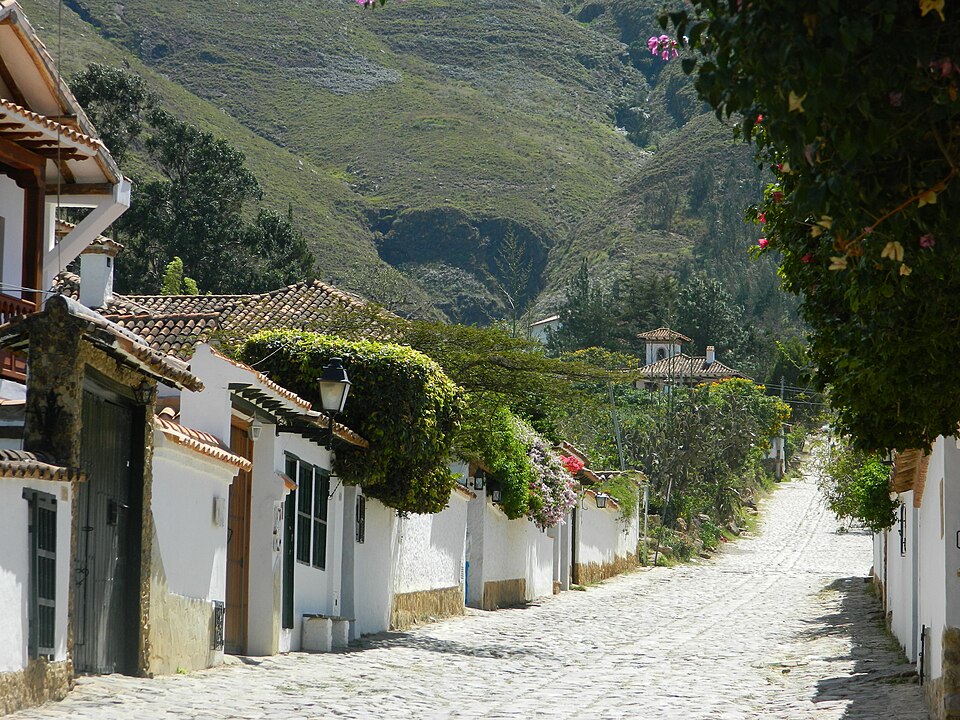
Long cobblestone street lined with colonial buildings beneath green mountains
A cobblestone street stretches beneath Villa de Leyva’s mountain backdrop

Villa de Leyva’s Colonial Plaza and Whitewashed Streets

Notably, at the heart of Villa de Leyva sits an enormous plaza. Even so, it can feel almost empty, even on a busy weekend. Surrounding streets, meanwhile, fan out from this square in a strict colonial grid. Specifically, each one is lined with single and two story buildings that have barely changed since Spanish rule. In fact, the town was never a major commercial or political center. Consequently, it avoided much of the modernization that reshaped other Colombian cities. As a result, Villa de Leyva today offers one of the most complete colonial streetscapes in the country.

The Largest Cobblestone Plaza in Colombia

Notably, Plaza Mayor spans roughly 14,000 square meters. That makes it one of the largest plazas in South America, and the largest in Colombia. Unlike most colonial squares, it has no central garden or grass. Instead, uneven cobblestones cover the entire surface. Then, they slope gently toward a stone fountain near one edge. Together with the whitewashed church of Our Lady of the Rosary, this fountain anchors the plaza visually and historically. In fact, the church’s bell tower remains one of the tallest structures in town. Consequently, it gives a clear view over the surrounding rooftops. Naturally, during the day, the plaza fills slowly with vendors, tourists, and locals crossing on their way to nearby shops. At night, however, it empties out almost completely. Still, only the fountain and church stay illuminated against the dark mountains behind them.

Stone water fountain in front of the church on Villa de Leyva's Plaza Mayor
The stone fountain and church tower on Villa de Leyva’s Plaza Mayor
Stone water fountain in front of the church on Villa de Leyva's Plaza Mayor
The stone fountain and church tower on Villa de Leyva’s Plaza Mayor

Wandering the Whitewashed Streets and Balconies

Beyond the plaza, Villa de Leyva’s streets also reward slow, aimless walking. Indeed, every block reveals another whitewashed facade. Every corner, similarly, brings another set of green or black shutters. Likewise, wooden balconies spill over with geraniums or bougainvillea throughout town.

Notably, several streets still carry small stone channels along their edges, where water once ran directly through town. Specifically, one such passage cuts between two buildings near the edge of the historic center. In fact, it stays narrow enough that only a single visitor can pass at a time. Furthermore, carved stone monoliths sit unexplained elsewhere along certain streets. Indeed, they are remnants of a pre-Columbian past that predates the Spanish town by centuries. Vintage vehicles occasionally add to the scene as well. Narrow cobblestone lanes have kept modern traffic largely out of the historic core. For those interested in local food, small courtyard restaurants tucked behind heavy wooden doors serve traditional Boyacá dishes. Bougainvillea drapes over their entrances, offering a welcome break between stops.

Cobblestone street with carved stone monoliths and colonial buildings in Villa de Leyva
Carved stone blocks line a quiet street in Villa de Leyva’s historic center
Narrow alley with a running stream between whitewashed buildings and mountains
A stream trickles through a narrow passage between colonial buildings
Vintage Ford pickup truck parked on a cobblestone street in Villa de Leyva
A vintage Ford truck parked along Villa de Leyva’s cobblestone streets
Wooden balcony overflowing with red and pink potted flowers in Villa de Leyva Colombia
A wooden balcony overflowing with geraniums and bougainvillea
Narrow cobblestone alley between a blue and a white colonial building in Villa de Leyva Colombia
A quiet cobblestone alley between a blue house and a white house
Restaurant entrance draped in bougainvillea at Verde Oliva in Villa de Leyva Colombia
A bougainvillea covered courtyard entrance at Verde Oliva restaurant

Los Portales and the Artisan Arcades

Along one side of the plaza, a covered arcade called Los Portales shelters a row of shops. Builders originally designed it to protect merchants and their goods from sun and rain. Today, the arcade houses artisan stalls selling woven baskets, ruanas, and other handcrafted goods. Nearby streets extend the same arched, covered walkway style. Long balconies run above ground floor shops and doorways. The Meson de Los Virreyes shows this style particularly well. It sits just off the plaza and ranks among the more elaborate colonial buildings in town. A carved stone entrance frames its doorway, flanked by wrought iron lanterns. Together, these arcades and balconies give Villa de Leyva’s commercial streets a unified, historic character.

Stone archways of Los Portales sheltering shops on Villa de Leyva's plaza in Villa de Leyva Colombia
Stone archways shelter artisan shops along Los Portales
Whitewashed colonial facade of Meson de Los Virreyes in Villa de Leyva
The colonial facade of Meson de Los Virreyes lines a cobblestone street
Long colonial building with a covered balcony and terracotta roof
A colonial building’s covered balcony lines the cobblestone street below

Casa Terracota: The World’s Largest Piece of Pottery

Just outside Villa de Leyva sits one of Colombia’s strangest buildings. It is a house made almost entirely from fired clay. Architect Octavio Mendoza began building Casa Terracota in the 1990s. He worked without a fixed blueprint, shaping the structure by hand over more than a decade. As a result, the building has no straight walls or sharp corners anywhere. Rounded domes, curving archways, and organic shapes flow into one another. The house looks closer to sculpture than architecture.

Locals often describe it as the largest piece of pottery in the world. That claim is hard to verify precisely, but the scale certainly supports it. Inside, the same clay construction continues. Built in furniture, staircases, and even a swimming pool are all shaped from the same reddish material. Visitors can walk through most of the interior for a small entrance fee. Narrow stairways lead up to rooftop viewpoints overlooking the surrounding valley. The house sits only a short taxi ride from Villa de Leyva’s center. Because of that, it makes an easy addition to a day exploring the town. Anyone curious about unconventional architecture will find it especially worthwhile.

Casa Terracota, a clay sculpture house near Villa de Leyva shaped like organic domes
Casa Terracota, the world’s largest piece of pottery near Villa de Leyva

Beyond the Town: Villa de Leyva’s Natural and Historic Surroundings

Villa de Leyva’s appeal extends well past its colonial core. Within a short drive, the surrounding countryside holds natural pools, fossil beds, monasteries, and shifting flower fields. Consequently, many visitors extend their stay beyond a single day just to fit in these nearby sights.

Pozos Azules and El Fósil: Villa de Leyva’s Natural Wonders

The Turquoise Pools of Pozos Azules

A short drive from town, Pozos Azules holds a small cluster of pools with strikingly turquoise water. High concentrations of minerals in the soil create the color, not any artificial source. Even so, it still looks almost too vivid to be natural. Visitors can walk along marked paths around the pools. Swimming is allowed in designated areas during dry months. Given the surrounding desert like landscape, the bright blue water stands out even more sharply against the tan hills.

Turquoise colored lake at Pozos Azules near Villa de Leyva
The strikingly turquoise waters of Pozos Azules

El Fósil and the Paleontological Museum Garden

Nearby, El Fósil protects the complete skeleton of a Kronosaurus. This marine reptile swam through the region roughly 110 million years ago. Back then, the area sat beneath a shallow sea. The fossil remains exactly where it was discovered. A protective structure now covers the excavation site directly. A short distance away, Villa de Leyva’s paleontological museum expands on this history further. Its garden displays additional fossil finds among palm trees and landscaped paths. Together, these sites make the region one of the richest fossil beds in Colombia.

Garden grounds at the paleontological museum in Villa de Leyva
The paleo garden at Villa de Leyva’s paleontological museum

The Convento del Santo Ecce Homo and the Flower Fields Beyond Town

A few kilometers outside Villa de Leyva, the Convento del Santo Ecce Homo offers a quieter, more contemplative stop. Founded in the seventeenth century, the monastery still functions today. Its stone cloister surrounds a manicured garden lined with arched columns. Visitors can tour parts of the building, including a chapel floor made from fossil filled stone slabs quarried nearby. Further from town, the countryside opens into rolling hills. Some are covered in seasonal flower crops that turn entire fields purple or pink, depending on the time of year. Elsewhere, small country estates and gardens dot the hillsides. Many feature terracotta roofed gazebos overlooking the valley below. For travelers with extra time, renting a car or joining a tour adds a very different rhythm to the trip. It contrasts nicely with Villa de Leyva’s dense, walkable streets.

Stone cloister with arched columns surrounding a manicured garden
The arched cloister of the Convento del Santo Ecce Homo near Villa de Leyva
Rolling green hills and purple flowering fields near Villa de Leyva
Purple flowering fields roll across the hills surrounding Villa de Leyva
Terraced garden with stone walls and terracotta roofed gazebos
Terraced gardens and roofed gazebos on a hillside near Villa de Leyva

One Historical Fact About Villa de Leyva, Colombia

Villa de Leyva holds a special place in Colombian independence history. It is the birthplace of Antonio Nariño, one of the key intellectual figures behind the country’s break from Spain. In 1794, Nariño translated and distributed the Declaration of the Rights of Man. Colonial authorities considered the document too radical, and Nariño was imprisoned and exiled multiple times as a result. Today, his former home in Villa de Leyva has been converted into a museum dedicated to his life and legacy. Given the town’s otherwise quiet, sleepy character, it can be easy to forget its history. Villa de Leyva played a genuine role in shaping Colombia’s path to independence.

Facade and entrance of the Casa Museo Antonio Nariño in Villa de Leyva
The facade of Casa Museo Antonio Nariño, birthplace of a Colombian independence hero

How to Get To Villa de Leyva, Colombia

Most visitors reach Villa de Leyva through Bogotá, Colombia’s capital and main international gateway. From there, buses depart regularly from Bogotá’s main bus terminal. The trip takes roughly three to four hours, depending on traffic and the route taken through Tunja. Alternatively, travelers with more flexibility can rent a car in Bogotá and drive directly. This allows for stops in smaller towns along the way. For those short on time, private transfers and organized day tours also run from Bogotá. Even so, an overnight stay is generally recommended given how much there is to see. Once in Villa de Leyva itself, the historic center is entirely walkable. A car becomes useful mainly for reaching outlying sights like Casa Terracota or Pozos Azules.

Best Time to Visit Villa de Leyva, Colombia

Villa de Leyva sits in a notably dry microclimate compared to much of Boyacá. That makes it a pleasant destination for much of the year. That said, the driest and sunniest months typically fall between December and March. Those months offer the clearest skies for walking the plaza and exploring the countryside. Weekends and Colombian holidays, however, bring noticeably larger crowds. Villa de Leyva remains a popular getaway for visitors from Bogotá. Consequently, visiting on a weekday, even outside the driest months, often makes for a quieter and more relaxed experience.

Is Villa de Leyva, Colombia Worth Visiting?

For travelers interested in colonial architecture, Villa de Leyva ranks among Colombia’s most rewarding stops. Its plaza and streets remain remarkably intact. They offer a clearer sense of colonial era life than many larger, more modernized cities. Furthermore, the surrounding countryside adds enough variety, from fossil beds to turquoise pools, that even a longer stay rarely feels repetitive. The town is undeniably touristy on weekends. Even so, it never quite feels overwhelmed, especially compared to more heavily visited destinations elsewhere in Colombia. Overall, Villa de Leyva earns its reputation as one of the country’s best preserved and most photogenic colonial towns.

Final Thoughts

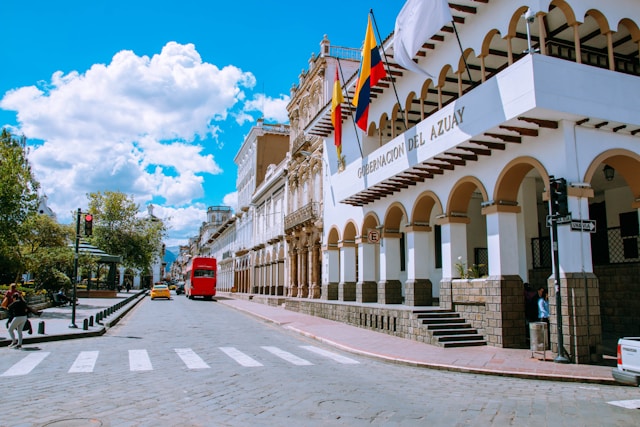
Villa de Leyva offers a rare mix of colonial history, strange architecture, and dramatic natural scenery. All of it fits into a town small enough to explore on foot. Whether wandering the plaza or climbing through Casa Terracota, visitors collect plenty of memories. Swimming in the turquoise pools of Pozos Azules adds even more. For travelers building a broader South American itinerary, Villa de Leyva pairs well with other colonial highlights across the continent. One example is Cuenca, Ecuador, another Andean city known for its own well preserved historic core.

Image Credits

Unsplash

  • Photo by Andrés Melo, Unsplash. Carved Stone Monoliths Along a Cobblestone Street.
  • Photo by Alex Mercier, Unsplash. A Narrow Alley With a Running Stream Between Colonial Buildings.
  • Photo by Julian, Unsplash. A Vintage Ford Truck Parked on a Cobblestone Street.

Pixabay

  • Photo by Makalu, Pixabay. Casa Terracota’s Organic Clay Domes and Archways.
  • Photo by Idearriba, Pixabay. A Bougainvillea Covered Courtyard Restaurant Entrance.
  • Photo by Makalu, Pixabay. The Arched Cloister of the Convento del Santo Ecce Homo.
  • Photo by Makalu, Pixabay. The Colonial Facade of Meson de Los Virreyes.
  • Photo by Makalu, Pixabay. A Wooden Balcony Overflowing With Geraniums and Bougainvillea.
  • Photo by Makalu, Pixabay. A Long Colonial Building With a Covered Balcony.

Pexels

Wikimedia Commons

  • Photo by ACHETORRESCC BY-SA 4.0, via Wikimedia Commons. A Whitewashed Cobblestone Street Beneath Green Mountains.
  • Photo by Compostar, CC0, via Wikimedia Commons. The Facade of Casa Museo Antonio Nariño.
  • Photo by FoturcolombiaCC BY 3.0, via Wikimedia Commons. The Plaza Fountain With the Church and Bell Tower Behind It.
  • Photo by Santiago LondoñoCC BY 3.0, via Wikimedia Commons. Purple Flowering Fields in the Hills Near Villa de Leyva.
  • Photo by LmalenaCC BY-SA 4.0, via Wikimedia Commons. Terraced Gardens and Gazebos on a Hillside Near Villa de Leyva.
  • Photo by AstromarioCC BY-SA 3.0, via Wikimedia Commons. The Turquoise Waters of Pozos Azules.
  • Photo by diego_cueCC BY-SA 3.0, via Wikimedia Commons. A Cobblestone Street Stretching Toward the Mountains.
  • Photo by Aztlek, Luis Alejandro Bernal RomeroCC BY-SA 3.0, via Wikimedia Commons. Stone Archways Sheltering Artisan Shops Along Los Portales.
  • Photo by Mavi9618CC BY-SA 4.0, via Wikimedia Commons. The Garden Grounds at Villa de Leyva’s Paleontological Museum.

Sources

Scroll to Top