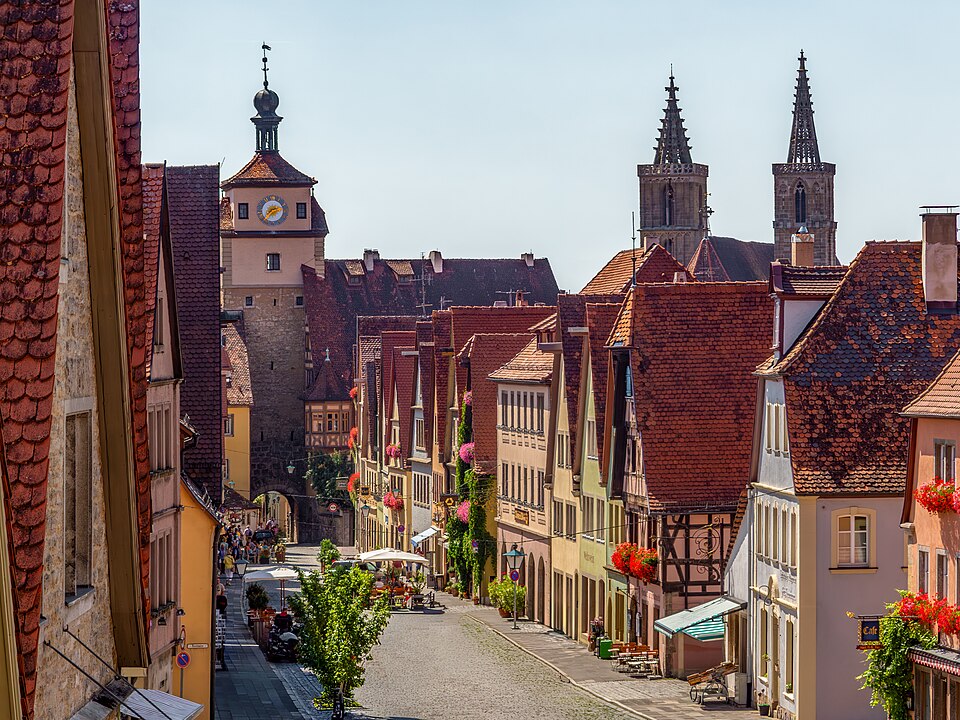
Some places promise a fairy tale and quietly disappoint. Rothenburg ob der Tauber is the rare town that actually delivers. Perched on a plateau above the Tauber River in Bavaria, it is widely considered the best-preserved medieval town in Germany. Cobbled lanes, leaning half-timbered houses, and a fully intact ring of stone walls have survived almost unchanged for centuries.
This is the town that helped inspire the romantic image of old Germany. Furthermore, it remains one of the most beloved stops on the Romantic Road Germany travelers follow between Würzburg and the Alps. Walk through any of its gates and you step into a townscape of red tiled roofs, ornate wrought-iron signs, and flower-filled window boxes. Many of its towers you can still climb. Whether you come for an afternoon or stay the night, Rothenburg surprises. There are more things to do here than its small size suggests.
This guide walks you through the town walls, the picturesque streets, the great market square, the famous iron signs, and everything else that makes Rothenburg ob der Tauber Germany’s most photogenic medieval survivor.
Quick Facts About Rothenburg ob der Tauber
| Country | Germany |
| Region | Middle Franconia, Bavaria |
| Known For | Medieval town walls, half-timbered houses, cobbled lanes, and the Plönlein |
| UNESCO Status | Not a UNESCO World Heritage Site |
| Founded | Medieval origins, documented from the 10th to 12th centuries, a Free Imperial City from 1274 |
| Best Time to Visit | Late spring and early autumn, plus Advent for the Christmas market |
| Time Needed | One full day, ideally with an overnight stay |
| Continent | Europe |
Where is Rothenburg ob der Tauber?
Rothenburg ob der Tauber sits in Middle Franconia, in the northern part of Bavaria, roughly halfway between Frankfurt and Munich. The full name is a useful clue to its setting: “ob der Tauber” means “above the Tauber.” As a result, the old town stands on a rocky plateau high above a bend in the Tauber River. Wooded valley slopes and vineyards fall away below the walls.
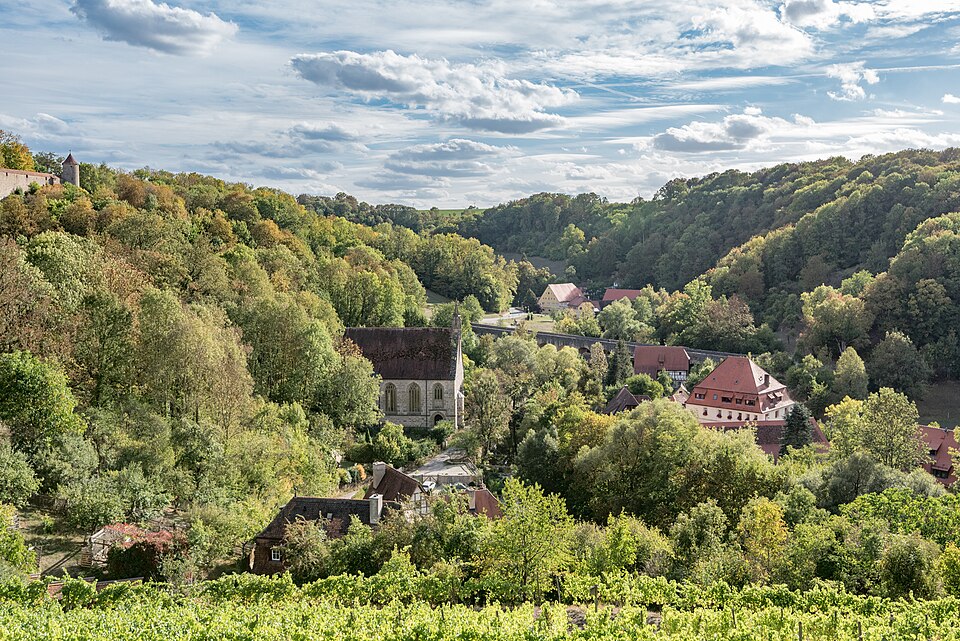
As a result, that elevated position is exactly why the town feels so dramatic. From the western edge of the old town, you look out over the green Tauber Valley. The small Gothic Kobolzeller church and a scatter of houses sit among the trees below. The same plateau that made Rothenburg a stronghold in the Middle Ages now gives visitors some of the loveliest views in Franconia. The town anchors the central section of the Romantic Road. Specifically, this scenic route links Würzburg in the north with Füssen and the Alps in the south.
Why Visit Rothenburg ob der Tauber?
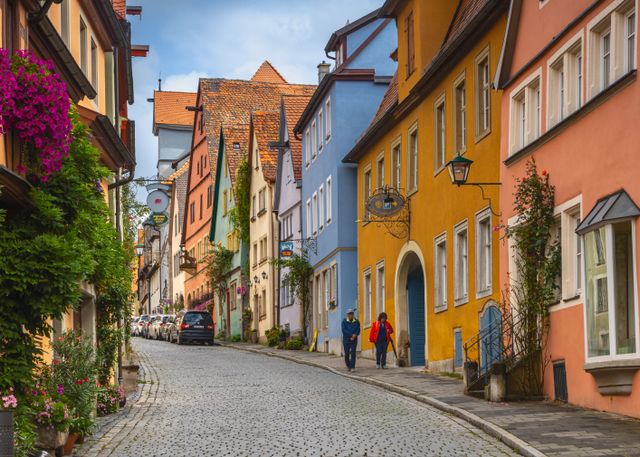
The short answer is completeness. Plenty of European towns keep a pretty square or a surviving gate. Few, however, preserve the entire medieval package the way this one does. Indeed, Rothenburg is in a category of its own. Rothenburg ob der Tauber kept its full circuit of walls, its towers, its gates, its market square, and street after street of original houses. As a result, the old town reads as a single, coherent medieval world rather than a handful of monuments stranded among modern buildings.
Moreover, it is remarkably walkable and rewarding for casual wandering. In fact, the best things to do in Rothenburg ob der Tauber are often the simplest. These include climbing the covered wall walk and following a cobbled lane. Looking up at the hand-forged guild signs is equally rewarding. Arrive early to find the quiet corners before the tour buses do. For lovers of history, photography, or just a beautiful place to slow down, this medieval town in Germany is hard to beat.
For more incredible European travel destinations, explore our full destinations guide.
Walk the Complete Medieval Town Walls of Rothenburg ob der Tauber
If you do only one thing here, walk the walls. The Rothenburg town walls form an almost unbroken ring around the old town. Much of the circuit is a covered wooden walkway you can stroll at roof height, looking down into gardens and out over the countryside. The full loop runs for roughly two and a half kilometers. Consequently, it is one of the most complete town wall systems anywhere in Germany.
Walking the Full Circuit of the Town Walls
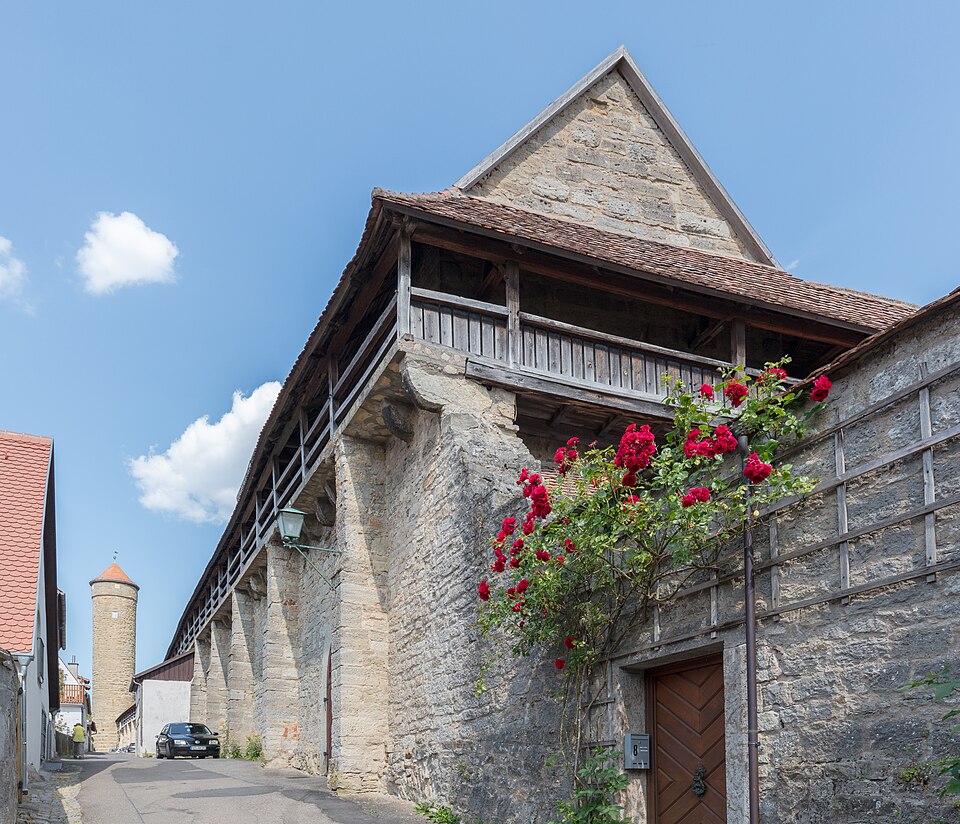
The walls are not a single uniform barrier but a layered defense built up over centuries. Stone ramparts, a roofed sentry walk, watchtowers at intervals, and climbing roses soften the old stonework in summer. In fact, you can join the wall walk at many points and follow it for as long as you like. Additionally, duck through towers and gatehouses as you go. Plaques along the parapet record donors from around the world who helped fund the reconstruction of sections damaged in 1945. They serve as a quiet reminder that the town’s perfect medieval face was partly rebuilt with care after the Second World War.
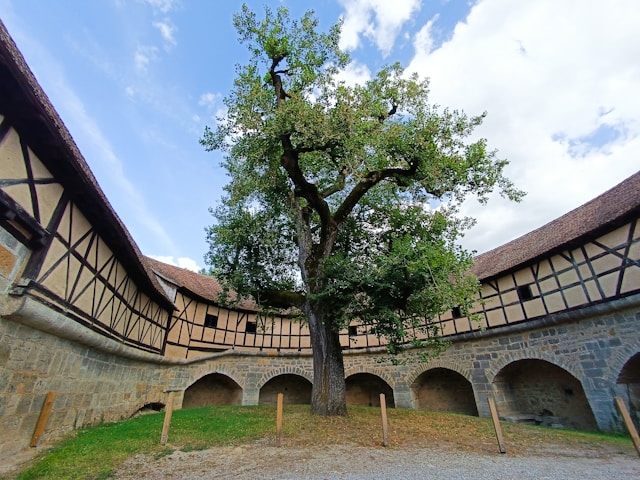
Tucked into the defenses are quieter spaces most visitors miss. One example is the round inner courtyard of a wall bastion, where galleries of timber framing ring a single old tree above a stone arcade. Therefore, these hidden pockets are part of the pleasure of the Rothenburg town walls. The circuit keeps revealing small, human-scaled corners between its grand military gestures.
The Great Gates and Bastions of the Rothenburg Town Walls
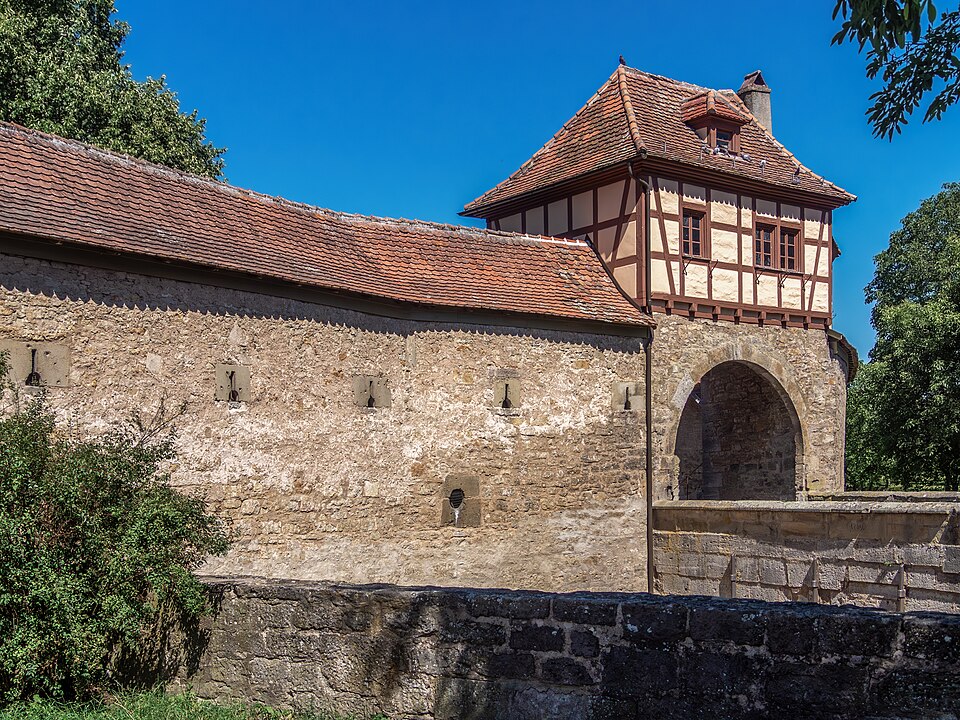
The walls are pierced by a series of fortified gates, each a small fortress in its own right. The Rödertor, on the eastern side, is one of the most characterful, a fortified gate where the covered wall walk meets a half-timbered tower above a stone arch. Gates like this controlled who entered the town and when. Moreover, several still carry their old guardhouses and inscriptions.
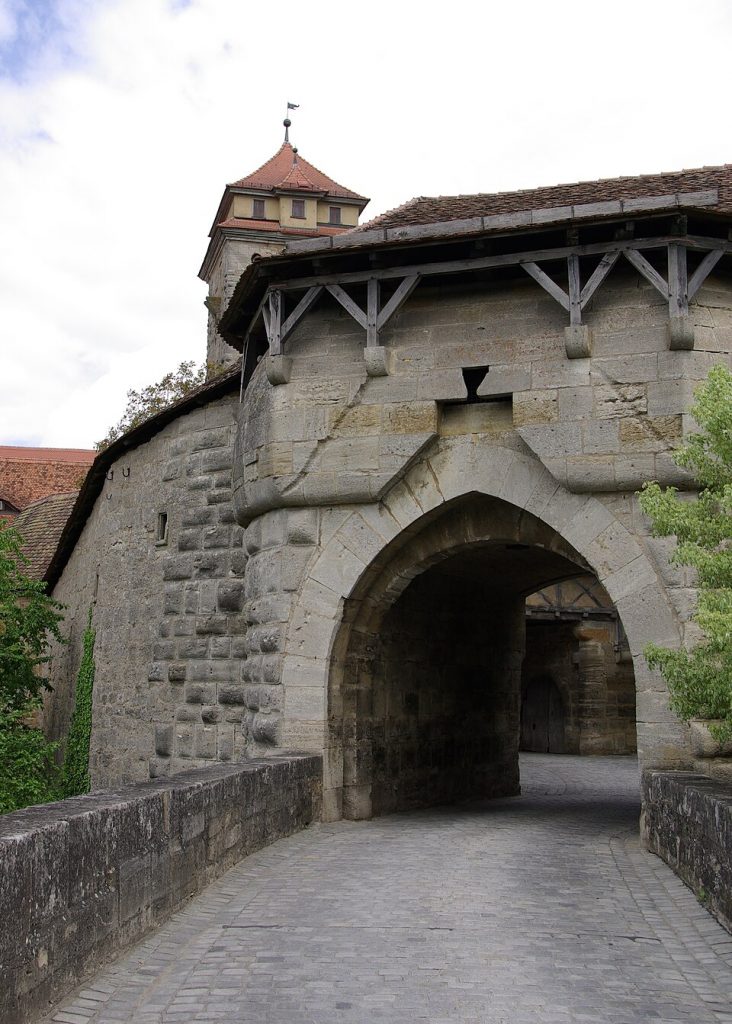
At the southern tip stands the Spitalbastei, the largest fortification on the wall. Furthermore, this massive bastion has pointed-arch gateways and layered defenses designed to slow any attacker who got this far. Walking through its stone passages, with the cobbles worn smooth underfoot, you get a real sense of how seriously this small town took its own protection.
Climbing the Towers for Rooftop Views Along the Romantic Road
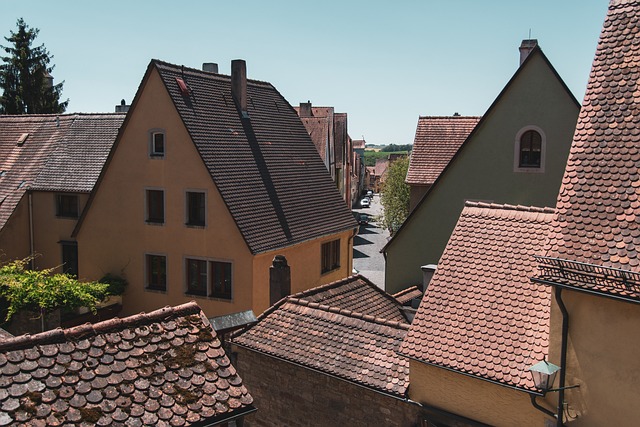
The reward for all that climbing is the view. From the wall walk and the climbable towers, Rothenburg becomes a sea of red clay tiles, with gabled roofs stacked tightly together and the open Franconian countryside beyond the walls. Indeed, even a short stretch of the parapet gives you a rooftop panorama that explains the town’s nickname as the jewel of the Romantic Road.
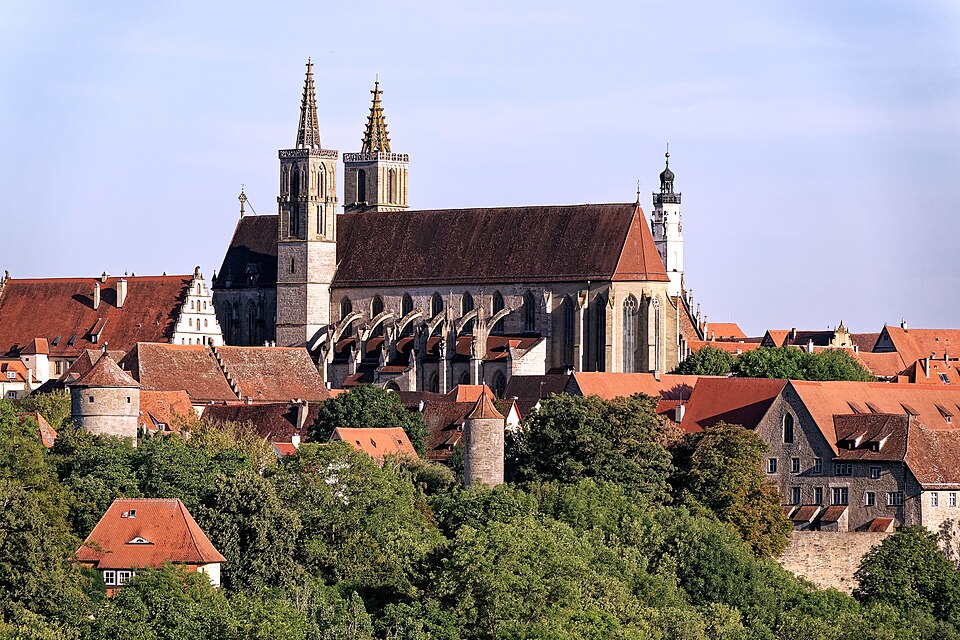
From the right vantage point, the twin towers of St. Jakobskirche rise above everything else. Furthermore, their Gothic spires and flying buttresses lift clear of the rooftops and the green slopes around the walls. It is the single most recognizable profile in town, and from outside the walls you can appreciate the sheer scale of the church against the small houses crowded at its feet.
Lose Yourself in Rothenburg’s Old Town Streets and Half-Timbered Houses
Once you come down off the walls, the real magic of Rothenburg old town is simply getting lost in it. The streets curve and slope and frame towers at their ends. Every block seems to offer another perfect composition of timber, plaster, and tile.
The Plönlein and Rothenburg’s Storybook Corners
The most famous corner of all is the Plönlein. A yellow half-timbered house stands at a little forked junction between two descending lanes, framed by the Siebersturm and Kobolzeller towers. It is probably the most photographed spot in town and, for many people, the very image that comes to mind when they picture old Germany. Indeed, even if you arrive knowing it from a hundred postcards, the Plönlein still stops you in your tracks.
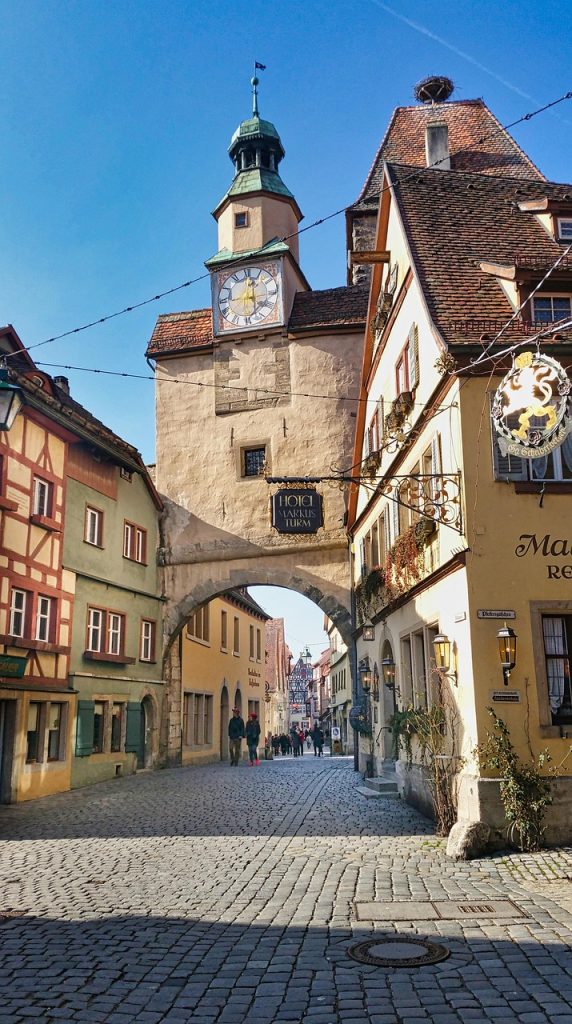
Similarly, the Markusturm is a medieval tower with a green spire and gilded clock that rises above the stone Röderbogen archway, flanked by colorful half-timbered houses. Moreover, spots like this are scattered all over the old town, which is why it pays to wander without a fixed plan.
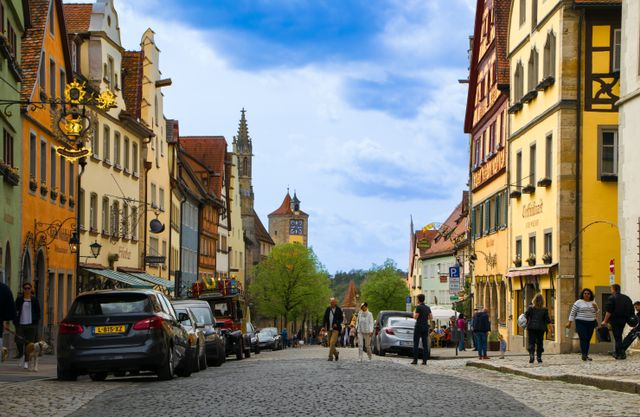
The main streets are lively and lined with cafes, guild signs, and shops, gently sloping toward a tower or a church spire at the far end. Follow almost any of them and you will end up somewhere worth photographing.
Half-Timbered Houses in Rothenburg’s Old Town
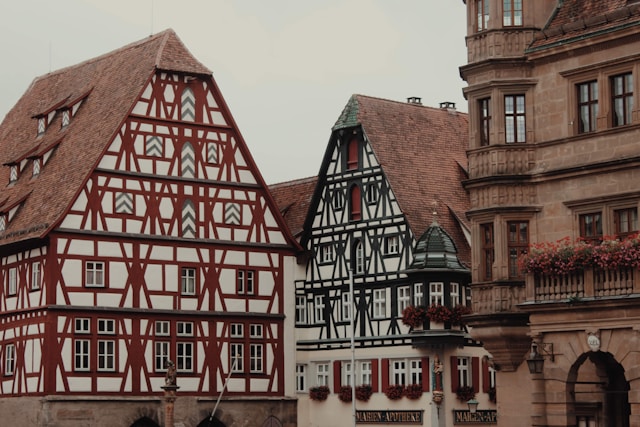
The houses themselves are the main event. Many of the grandest carry elaborate timber patterns, with red-and-white and black-and-white framing worked into chevrons and crosses across tall gables. In particular, near the market square, the ornate gables of houses like the Marien-Apotheke show off the wealth of the town’s merchant past.
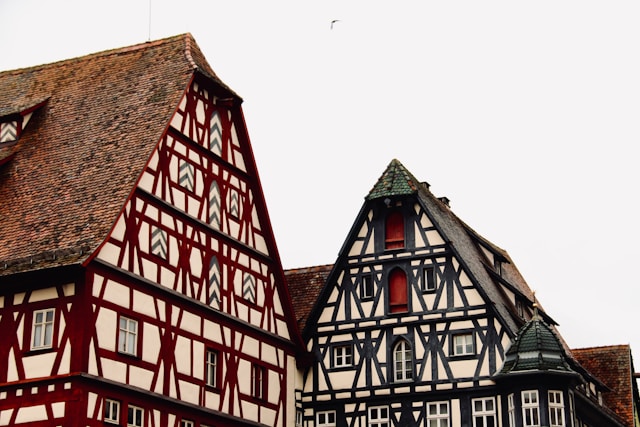
Furthermore, look up and the variety is endless, from steep stepped gables to delicate geometric framing picked out in deep red and black. In fact, no two facades are quite the same.
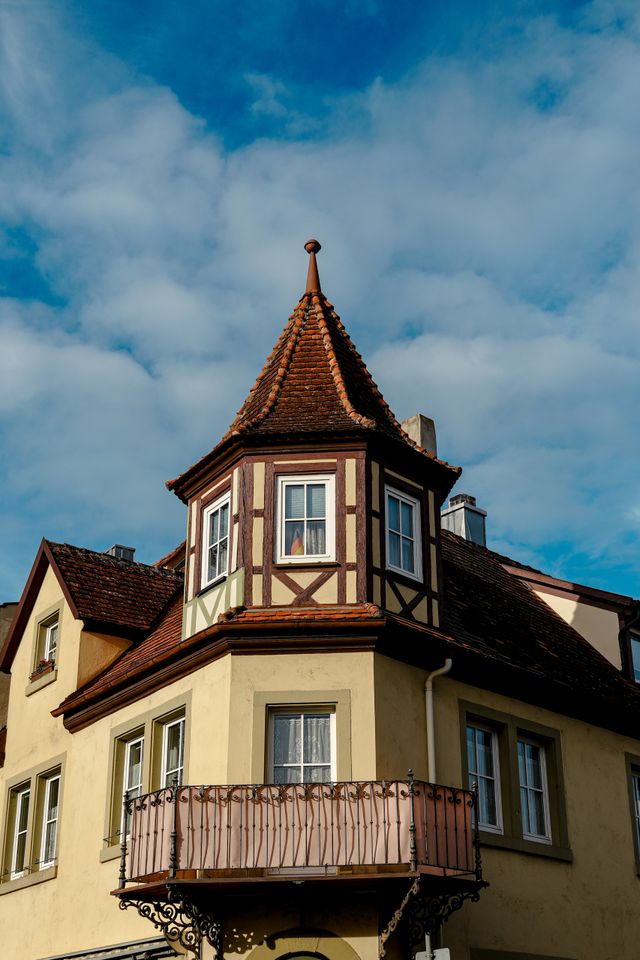
Small details reward a slow eye, like a projecting corner oriel turret clad in timber and topped by a steep tiled spire. These bay windows let medieval residents watch the street in both directions, and they remain one of the town’s most charming architectural quirks.
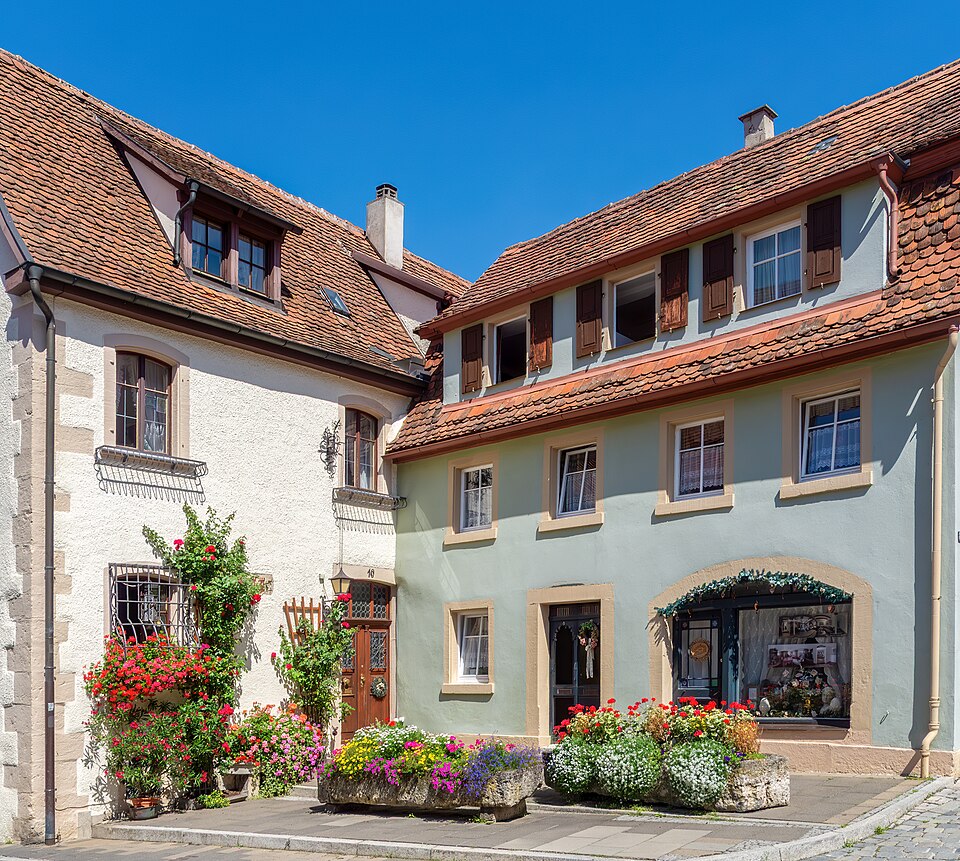
Away from the busiest streets, residential corners such as those on Klingengasse are quieter and just as pretty. Stone troughs brim with geraniums and climbing roses frame the doorways. Indeed, this is where Rothenburg old town feels most like a place people actually live.
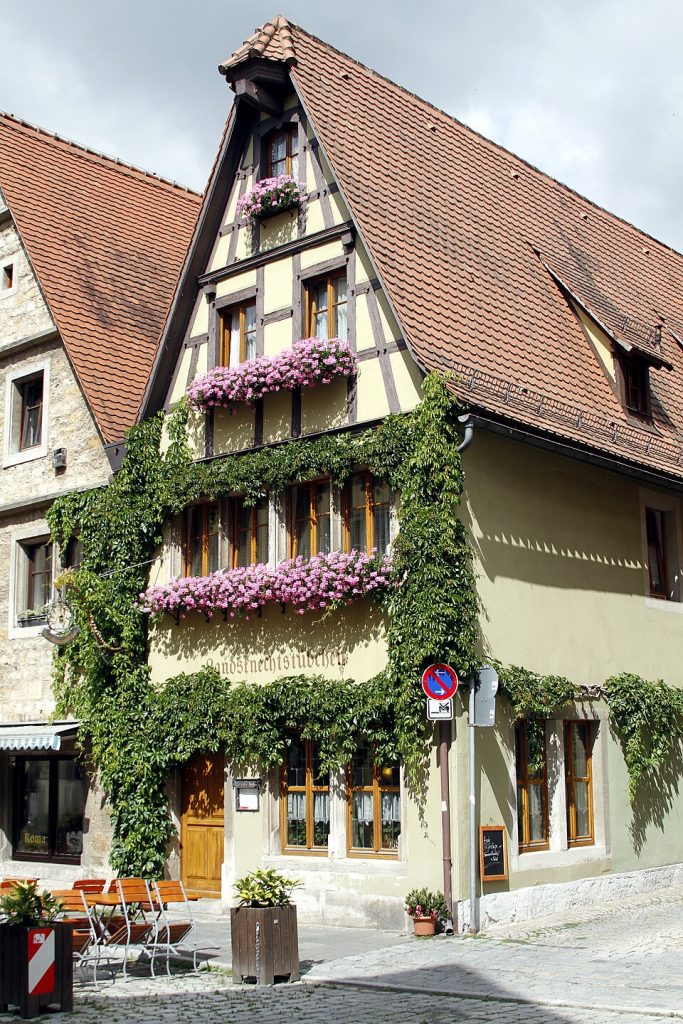
One especially photogenic example is the Landsknechtstube, a pale half-timbered corner house wrapped in climbing ivy with cascading pink geraniums spilling from its window boxes. In summer, consequently, the greenery nearly swallows the facade.
The Gerlachschmiede, a Fairy-Tale Smithy
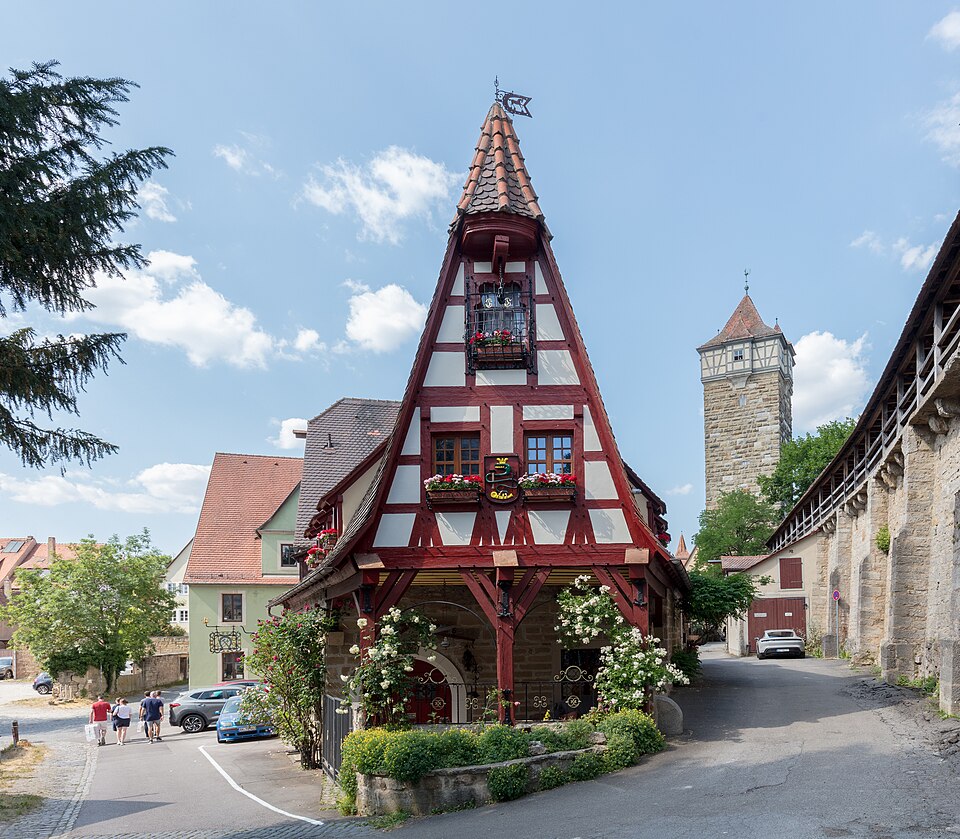
Near the Rödertor stands one of the most beloved buildings in town, the Gerlachschmiede, a former blacksmith’s house with an extravagantly tall, pointed roof. Draped in climbing roses, with the stone Röderturm and the covered wall walk rising behind it, the old smithy looks like something drawn for a fairy tale. Consequently, it is one of the most photographed buildings in town. Indeed, it is a favorite of photographers and a perfect example of how even a working craftsman’s house in Rothenburg ob der Tauber was built with real flair.
The Marktplatz, St. Jakobskirche, and the Famous Iron Signs
At the center of it all is the Marktplatz, the market square that has been the social and civic heart of the town for centuries. Around it cluster the grandest buildings, the most important church, and many of the wrought-iron signs the town is famous for.
The Marktplatz, Heart of Rothenburg’s Old Town
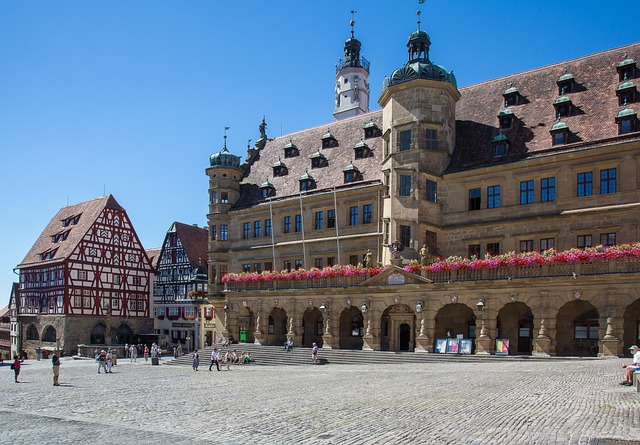
The Town Hall, or Rathaus, dominates the square. It combines an older Gothic wing with a grand Renaissance front. Its tall white tower offers one of the best views in town for those willing to climb the narrow stairs. The arcaded ground floor and broad steps spill out onto the cobbles. Indeed, the square has hosted markets, ceremonies, and gatherings for hundreds of years.
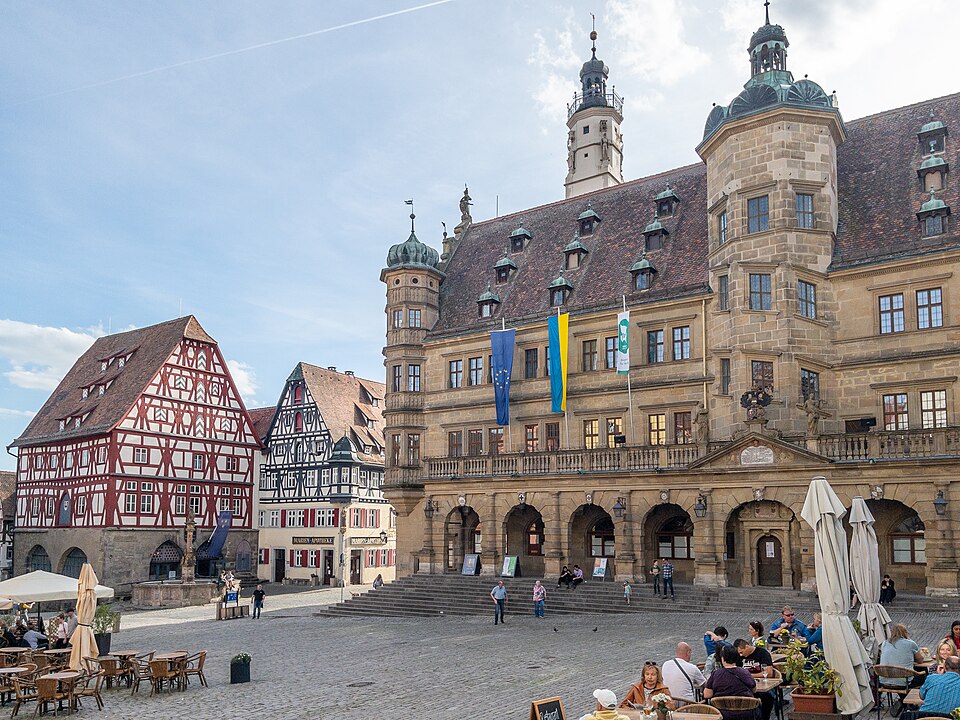
Today the Marktplatz is ringed with cafe terraces and framed by ornate half-timbered gable houses. Furthermore, on a sunny day it is one of the most pleasant places in town to sit with a coffee and watch the world go by.
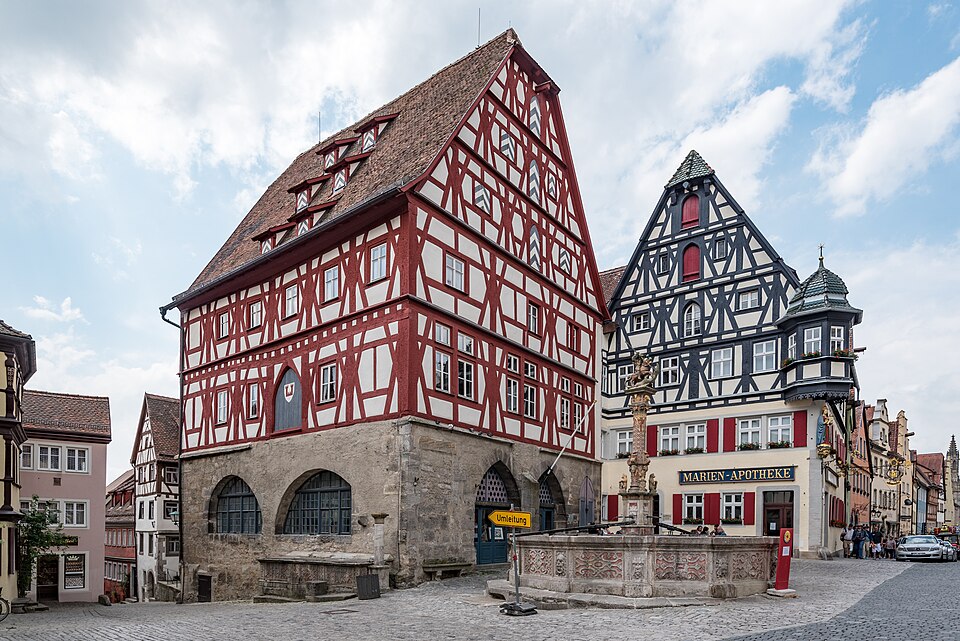
Just off the main square, grand half-timbered buildings rise beside the Marien-Apotheke, with the tall Renaissance Georgsbrunnen fountain standing on the cobbles between them.
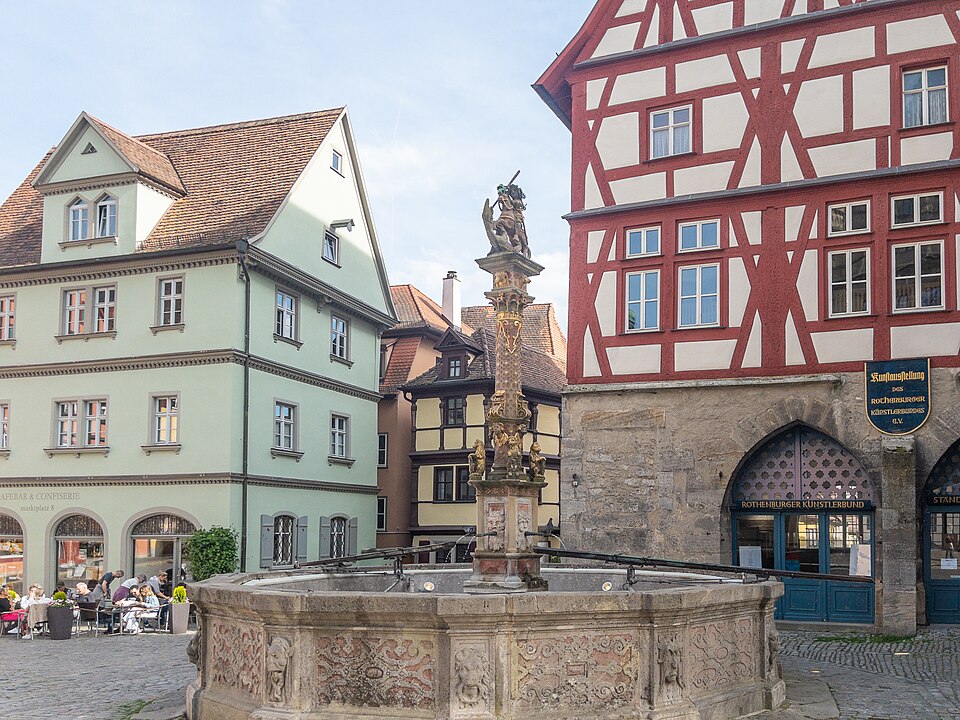
The Georgsbrunnen is far more than a water source. Topped by a statue of St. George and decorated with carved heraldry, it was one of the town’s most important wells. Consequently, it remains a beautiful piece of Renaissance craftsmanship in the open air.
St. Jakobskirche and the Holy Blood Altar
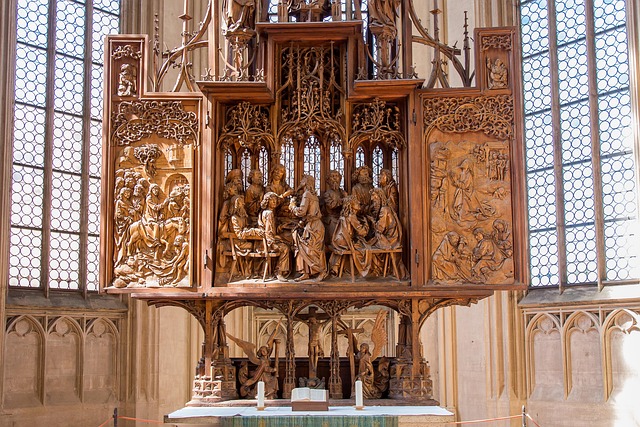
The town’s principal church, St. Jakobskirche, is a soaring Gothic structure begun in the 14th century. Furthermore, its greatest treasure is the Holy Blood Altar. Carved around 1500 by the master sculptor Tilman Riemenschneider, this limewood altarpiece depicts the Last Supper in astonishing detail. Notably, Judas sits at the very center of the composition. Consequently, lit by the tall Gothic windows behind it, the altar is considered one of the finest works of late medieval German woodcarving, and it alone is worth the price of entry to the church.
Wrought-Iron Guild Signs of Rothenburg ob der Tauber
One of the quiet delights of the old town is looking up. Above the shops and inns hang dozens of elaborate wrought-iron signs, hand-forged and often gilded. They advertise trades and businesses in a tradition reaching back to the days when many people could not read. Each one is a small sculpture. Together, therefore, they form an open-air gallery of the blacksmith’s art.
Hotel and Tavern Signs
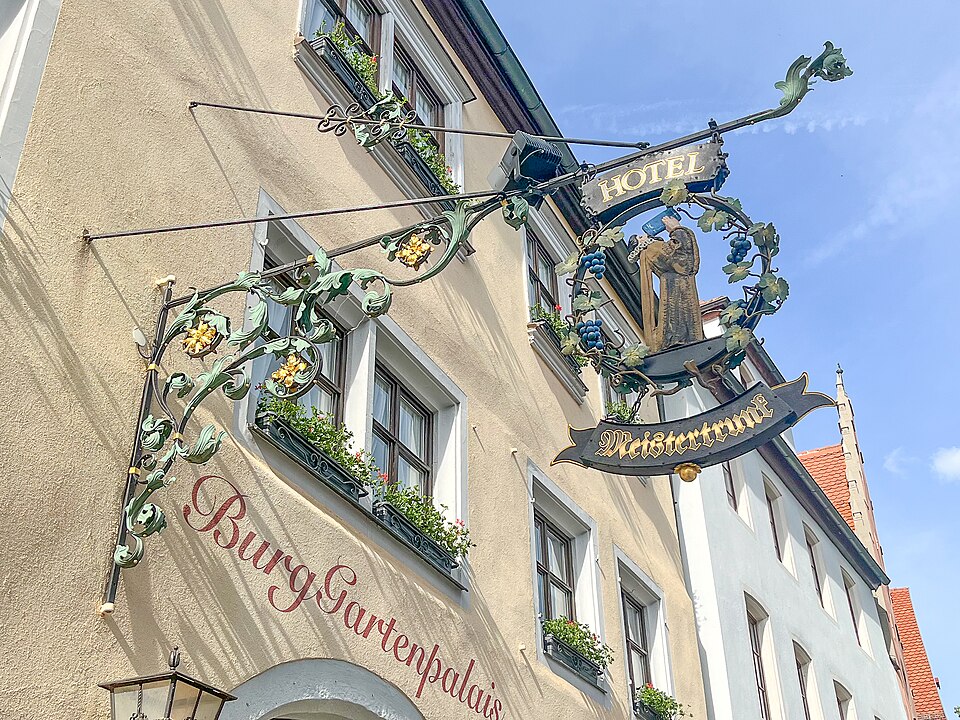
Many of the grandest signs hang from hotels and restaurants. For example, the Hotel Meistertrunk sign, entwined with iron grapevines and a figure draining a tankard, directly recalls the town’s most famous legend.
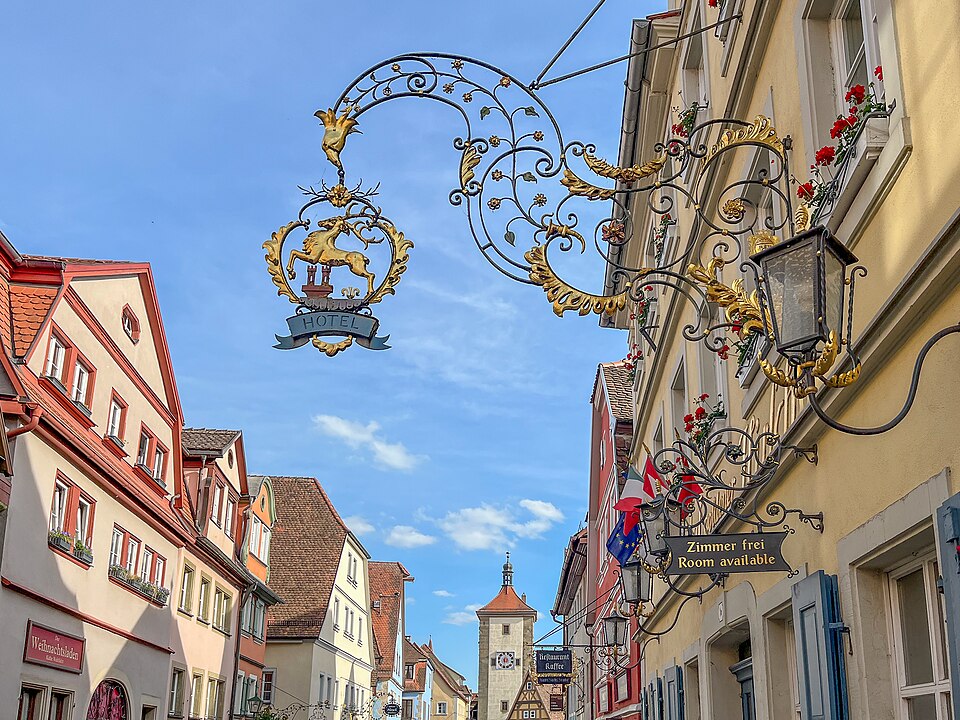
Others reach right across the lane, like the gilded stag hotel sign that arches over the street with a medieval tower closing the view behind it.
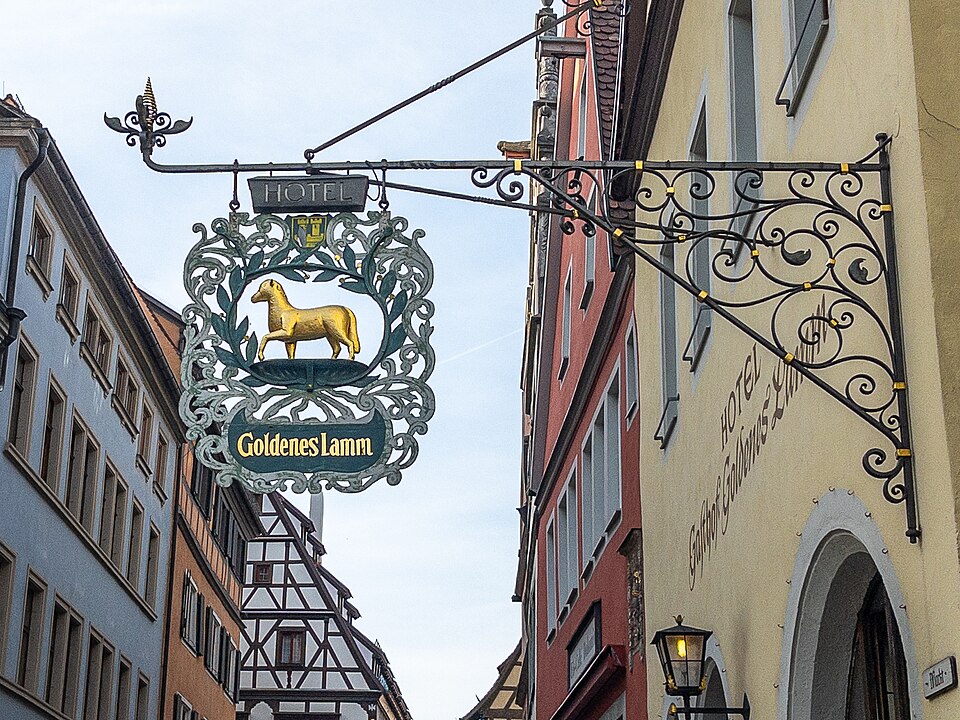
The Goldenes Lamm, or Golden Lamb, hangs from a frame of green and gold ironwork crowned with a gilded lamb, a classic example of the inn signs that have welcomed travelers here for generations.
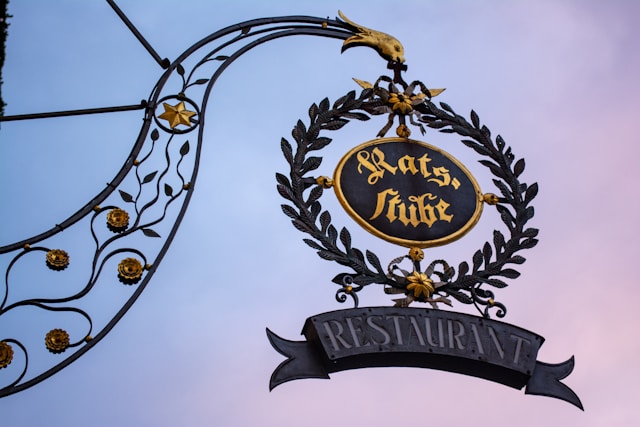
Caught against a soft dusk sky, the Rats-Stube restaurant sign shows just how sculptural these pieces become, with a laurel wreath, a gilded bird, and flowing scrollwork.
Craft and Shop Signs
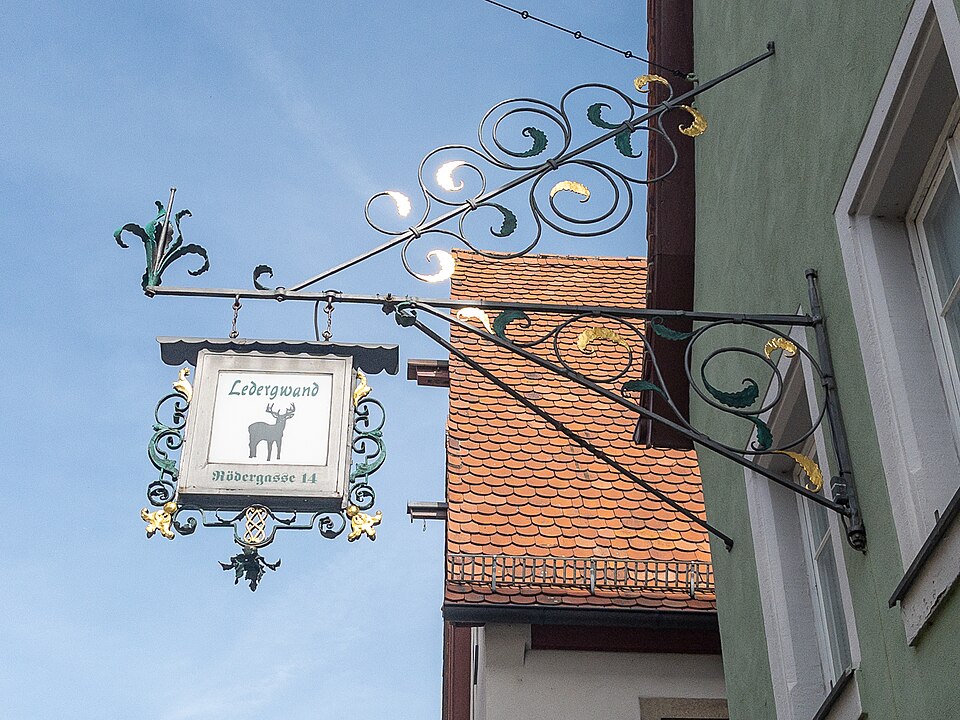
The trades have their own signs too. On Rödergasse, an ornate iron sign with gold and green accents bears a stag emblem for Ledergwand, a leather goods maker.
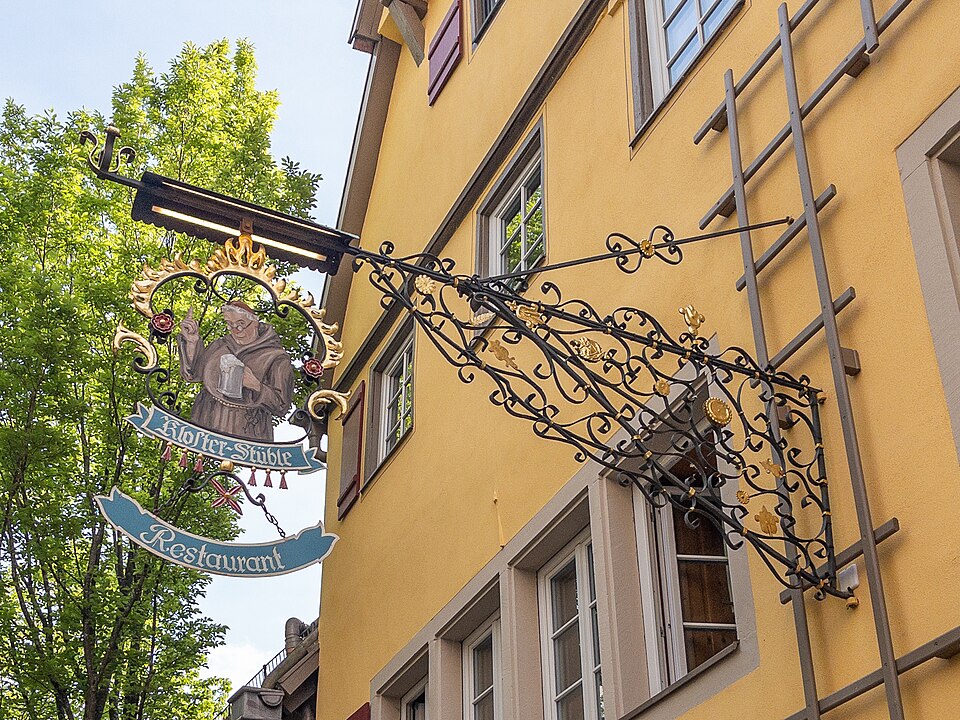
The Kloster-Stüble sign adds a painted panel of a cheerful monk raising a tankard, a witty nod to the monastic brewing traditions of the region.
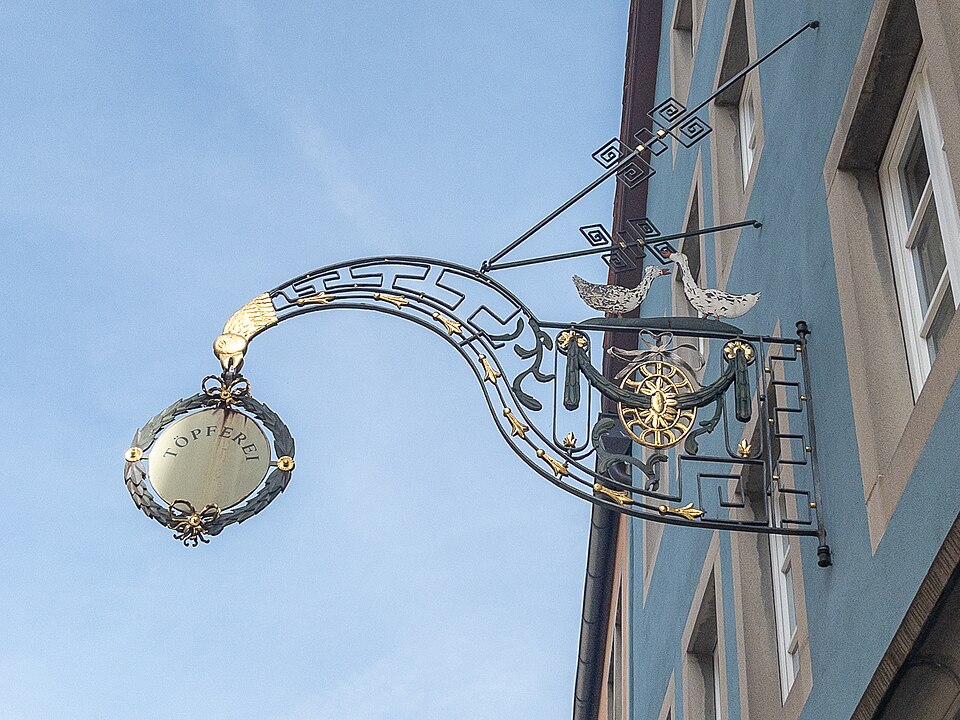
Similarly, a potter’s workshop announces itself with a flowing iron sign reading Töpferei, decorated with a golden bird and a pair of white geese. Spotting and identifying these signs is one of the most enjoyable free things to do in Rothenburg ob der Tauber. In fact, once you start looking up you will not want to stop.
The Burggarten and Views Over the Tauber Valley
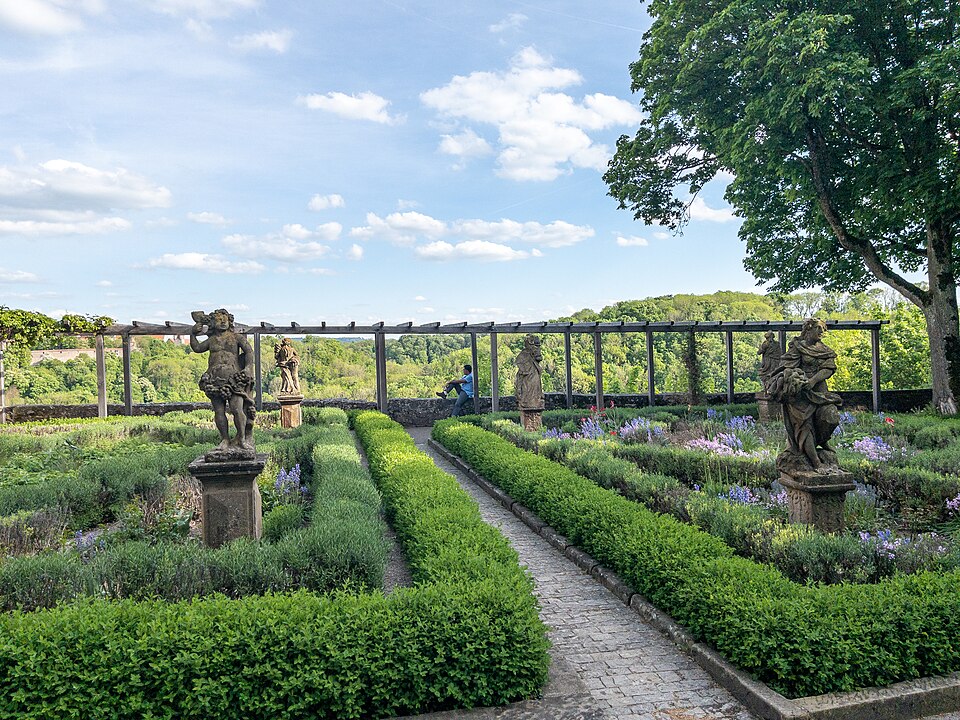
At the western edge of the old town lies the Burggarten, a peaceful castle garden laid out on the site of a former imperial fortress that was destroyed by an earthquake in the 14th century. Today, clipped box hedges, lavender beds, and weathered baroque statues line the pergola walks. Moreover, the garden’s terrace offers some of the finest views over the wooded Tauber Valley. As a result, it is the perfect place to escape the busiest streets and watch the light change over the countryside below.
One Historical Fact About Rothenburg ob der Tauber
The town’s best-loved story is the legend of the Meistertrunk, or Master Draught. In 1631, during the Thirty Years’ War, Catholic imperial forces under General Tilly captured the town. The legend says they threatened to destroy it. Tilly reportedly offered a wager. If a councilman could drain a tankard holding more than three liters of wine in a single draught, the town would be spared. According to the tale, the former mayor Georg Nusch rose to the challenge and drained it, saving Rothenburg from destruction.
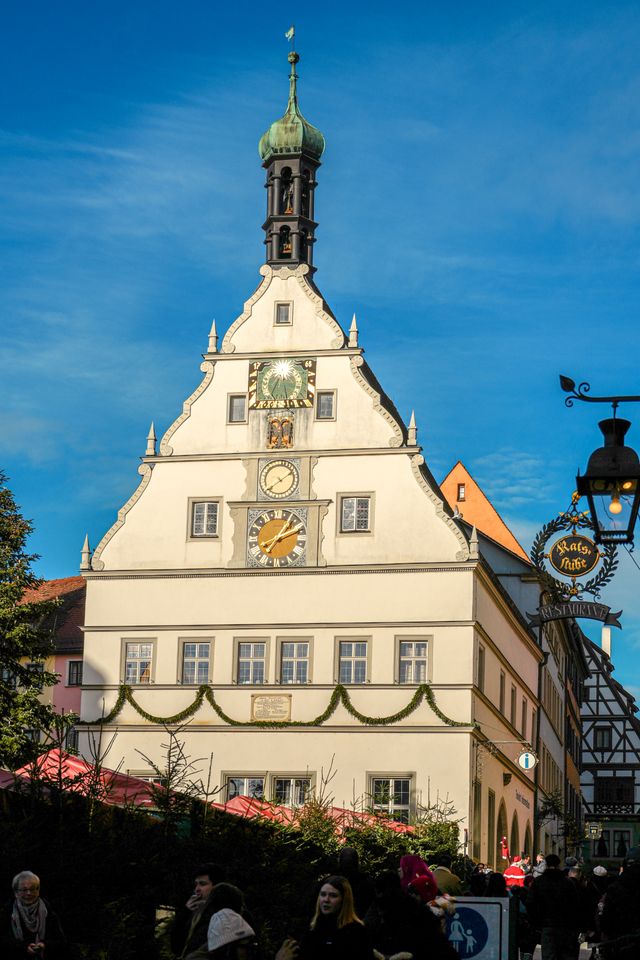
Historians treat the story as legend rather than verified fact. Nevertheless, the town has embraced it wholeheartedly. On the Marktplatz, the gabled facade of the Ratstrinkstube carries a clock with mechanical windows. They swing open several times a day so two painted figures can reenact the famous drinking feat. Additionally, the Meistertrunk is celebrated each year with a costumed festival, keeping a four-hundred-year-old legend very much alive.
How to Get To Rothenburg ob der Tauber
Getting to Rothenburg ob der Tauber takes a little planning, which is part of why it has kept its quiet charm. The town sits just off the A7 motorway, making it easy to reach by car. Furthermore, it lies squarely on the Romantic Road Germany route, so many visitors arrive as part of a longer scenic drive. Renting a car also makes it simple to combine Rothenburg with other walled towns nearby, such as Dinkelsbühl. In addition, these share the same medieval character and make for an easy detour.
By train, you typically change at Steinach, a short branch-line ride from the main lines connecting Würzburg, Ansbach, and Nuremberg. From cities like Würzburg, Nuremberg, Munich, or Frankfurt, a day trip is very doable. However, staying overnight is the real secret, and consequently the experience feels entirely different. After the day-trippers leave in the late afternoon, the streets empty out. The town becomes quiet and almost private — that is when it is at its most magical.
Best Time to Visit Rothenburg ob der Tauber, Germany
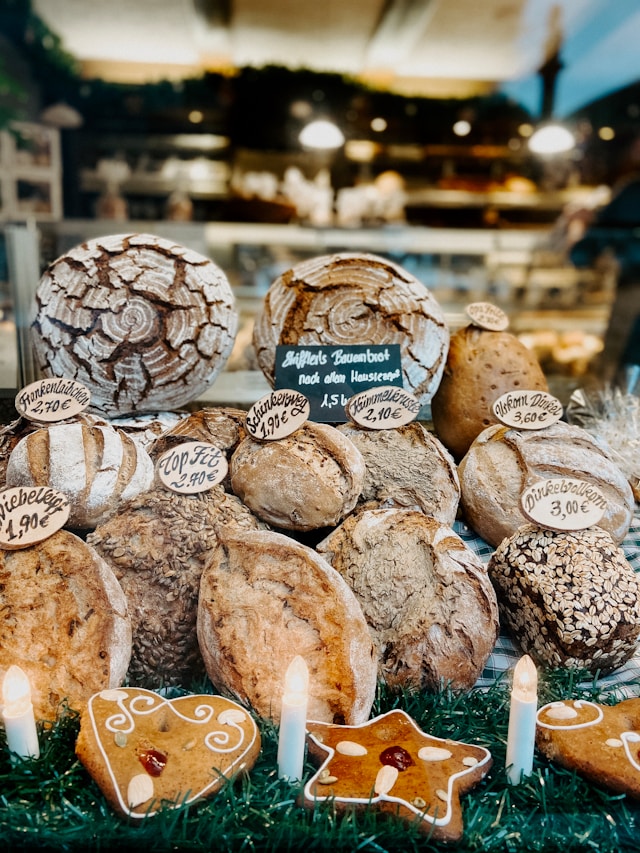
Late spring and early autumn are the sweet spots. The weather is mild, daylight is long, and flowers spill from window boxes without the heaviest summer crowds. Summer is beautiful but busy. Therefore, early mornings and evenings are your friends. Winter brings a different kind of charm entirely. During Advent, the Reiterlesmarkt — one of Germany’s most atmospheric Christmas markets — fills the Marktplatz with stalls. Additionally, bakery windows overflow with rustic Franconian breads and iced gingerbread. Whenever you come, moreover, save room for the town’s famous Schneeballen. These deep-fried pastry balls come dusted with sugar or coated in chocolate and appear in shop windows all over the old town.
Is Rothenburg ob der Tauber, Germany Worth Visiting?
So, is Rothenburg ob der Tauber worth visiting? Without hesitation, yes. Few places in Europe let you step so completely into the Middle Ages. Fewer still do it while remaining a real, lived-in town rather than a museum piece. In particular, the combination of intact walls, climbable towers, picture-perfect streets, a great church, and those endlessly inventive iron signs adds up to something genuinely special.
It is fair to say the town is popular, and in peak season the main streets can feel crowded in the middle of the day. However, that is easily managed. Therefore, arrive early, stay late or overnight, and explore the wall walk and the side lanes. As a result, you will have much of this medieval town largely to yourself. For anyone drawn to history, architecture, or simply beautiful places, Rothenburg more than earns its reputation.
Final Thoughts
Rothenburg ob der Tauber is the kind of place that lingers long after you leave. For instance, it is the cobbled lanes that frame a tower at every turn, the rooftop views over the Tauber Valley, the carved faces on a Renaissance fountain, and the iron signs swinging gently above the streets. Furthermore, it is a town that was nearly lost and lovingly preserved, and it remains the brightest jewel on the Romantic Road. Therefore, give it a full day, stay the night if you can, and let yourself get lost in the most complete medieval town in Germany.
If you enjoy medieval towns, you may also love Chefchaouen Morocco, another beautifully preserved historic destination with a distinctive atmosphere.
Image Credits
Town Walls and Gates
- View down Galgengasse toward the Weißer Turm and St. Jakobskirche — Reinhold Möller Ermell, CC BY-SA 4.0, via Wikimedia Commons
- The medieval town wall with its covered sentry walk — Diego Delso, CC BY-SA 4.0, via Wikimedia Commons
- The Rödertor gate — Reinhold Möller Ermell, CC BY-SA 4.0, via Wikimedia Commons
- Gate passage of the Spitalbastei — Janericloebe, Public domain, via Wikimedia Commons
- Inner courtyard of a town wall bastion — Photo by Tomasz Anusiewicz on Unsplash


Streets and Architecture
- A colorful cobbled lane — Photo by Sergey Guk from Pexels
- An old town street toward a tower and church spire — Photo by Esmerald Heqimaj from Pexels
- A flower-decked corner on Klingengasse — Reinhold Möller Ermell, CC BY-SA 4.0, via Wikimedia Commons
- The Markusturm and Röderbogen — Image by Mustafa Makinist from Pixabay
- A half-timbered corner oriel — Photo by Author from Pexels
- Decorative gables of two half-timbered houses — Photo by Serge Taeymans on Unsplash
- Half-timbered gable houses on the Marktplatz — Photo by jordi on Unsplash
- The ivy-clad Landsknechtstube house — © José Luiz Bernardes Ribeiro
- The Gerlachschmiede with the Röderturm behind — Diego Delso, CC BY-SA 4.0, via Wikimedia Commons


Marktplatz and Churches
- The Town Hall on the Marktplatz — Image by Th G from Pixabay
- The Marktplatz and Renaissance Town Hall — Kent Wang, CC BY-SA 2.0, via Wikimedia Commons
- Marktplatz buildings and the Georgsbrunnen — Tilman2007, CC BY-SA 4.0, via Wikimedia Commons
- The Georgsbrunnen fountain — Kent Wang, CC BY-SA 2.0, via Wikimedia Commons
- A walled town square on the Romantic Road — Photo by Magda Ehlers from Pexels
- The Holy Blood Altar in St. Jakobskirche — Image by Th G from Pixabay
- The Ratstrinkstube clock gable — Photo by 0xd1ma from Pexels


Rooftop Views and Landscape
- A view over the red tiled rooftops — Image by Michał from Pixabay
- St. Jakobskirche above the rooftops — Holger Uwe Schmitt, CC BY-SA 4.0, via Wikimedia Commons
- The Tauber Valley and Kobolzeller church — Tilman2007, CC BY-SA 4.0, via Wikimedia Commons
- The Burggarten castle garden — Kent Wang, CC BY-SA 2.0, via Wikimedia Commons


Iron Signs and Local Details
- The Ledergwand guild sign — Kent Wang, CC BY-SA 2.0, via Wikimedia Commons
- The Kloster-Stüble restaurant sign — Kent Wang, CC BY-SA 2.0, via Wikimedia Commons
- The Töpferei pottery sign — Kent Wang, CC BY-SA 2.0, via Wikimedia Commons
- The Hotel Meistertrunk sign — Kent Wang, CC BY-SA 2.0, via Wikimedia Commons
- A gilded stag hotel sign over the street — Kent Wang, CC BY-SA 2.0, via Wikimedia Commons
- The Goldenes Lamm hotel sign — Kent Wang, CC BY-SA 2.0, via Wikimedia Commons
- The Rats-Stube restaurant sign at dusk — Photo by Fabian Kleiser on Unsplash


Food and Markets
- A bakery display of breads and gingerbread — Photo by Corinne Kutz on Unsplash