
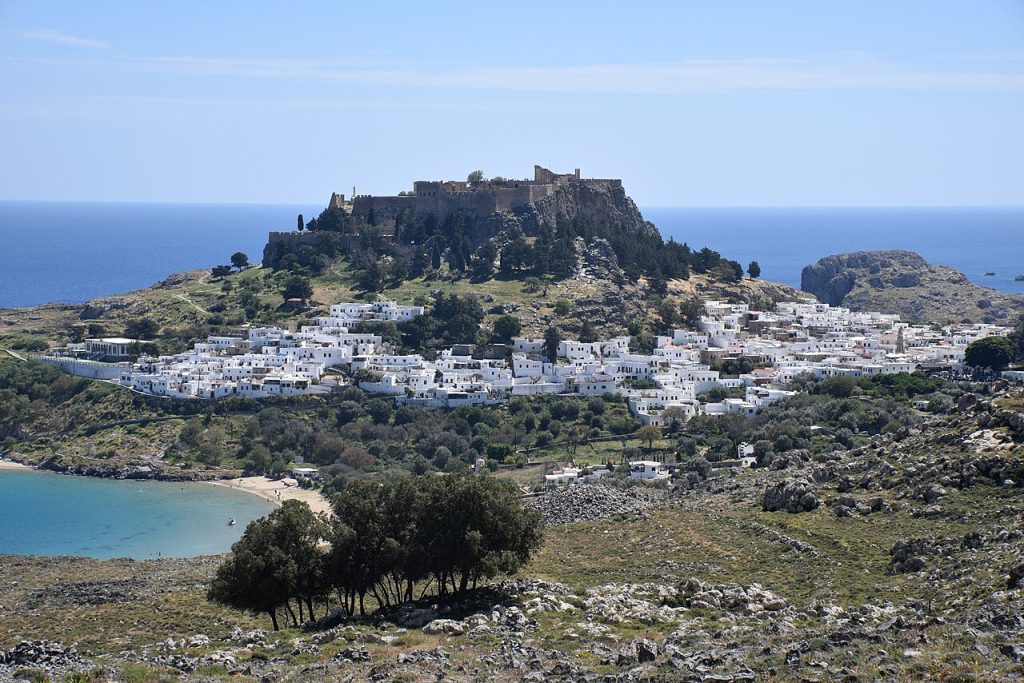
Lindos Greece is a dazzling white village on the island of Rhodes, crowned by an ancient Acropolis on a rocky hill. Narrow lanes wind between whitewashed houses, while two turquoise bays sparkle below. Moreover, few places in Greece combine such beauty with so many layers of history. So, this guide covers what to see, how to get there and when to go.
Quick Facts About Lindos, Greece
| Country | Greece |
| Region | East coast of Rhodes, Dodecanese |
| Known For | Acropolis of Lindos, whitewashed lanes, captains houses, St Paul’s Bay |
| UNESCO Status | Not listed |
| Founded | Around the 10th century BC, as a Dorian city |
| Best Time to Visit | May to June and September to October |
| Time Needed | 1 day |
| Continent | Europe |
Where Is Lindos, Greece?
Lindos lies on the east coast of Rhodes, the largest of the Dodecanese islands in the southeastern Aegean. More precisely, it sits between a rocky headland and two sheltered bays. In addition, Rhodes Town is about an hour away by road to the north.
Why Visit Lindos, Greece?
First, the Acropolis of Lindos is one of the most spectacular ancient sites in the Greek islands. Second, the village below is a maze of white houses, pebble courtyards and small churches. Also, the beaches here are some of the prettiest on Rhodes.
In addition, Lindos has a long and rich history. For example, it was a powerful city in ancient times, and later it became a stronghold of the Knights of Saint John. As a result, every corner tells a story.
Climbing the Acropolis of Lindos
The Path to the Top
A steep path leads up from the village to the Acropolis, and the walk takes around 15 to 20 minutes. Along the way, local women sometimes sell lace and embroidered tablecloths. Near the entrance, look for a relief of an ancient warship carved into the rock.
The Temple of Athena Lindia
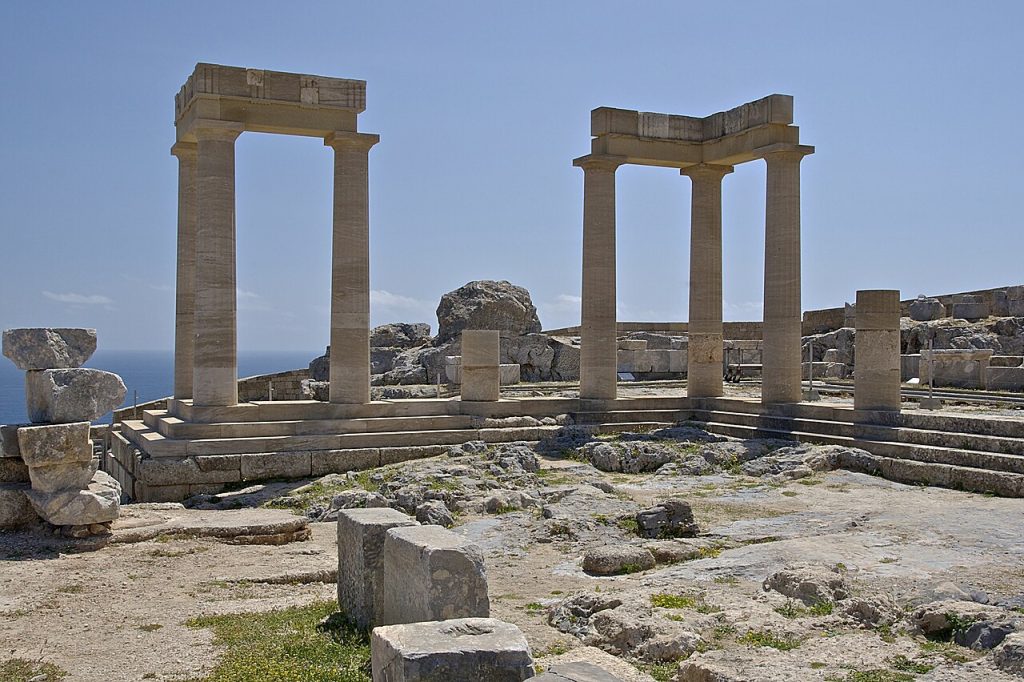
At the top stands the Temple of Athena Lindia, which reached its final form around 300 BC. Below it, a grand Hellenistic stoa once stretched for 87 meters, with 42 columns. Today, several of these columns have been raised again. Therefore, you can still imagine how impressive the sanctuary must have looked.
The Castle of the Knights
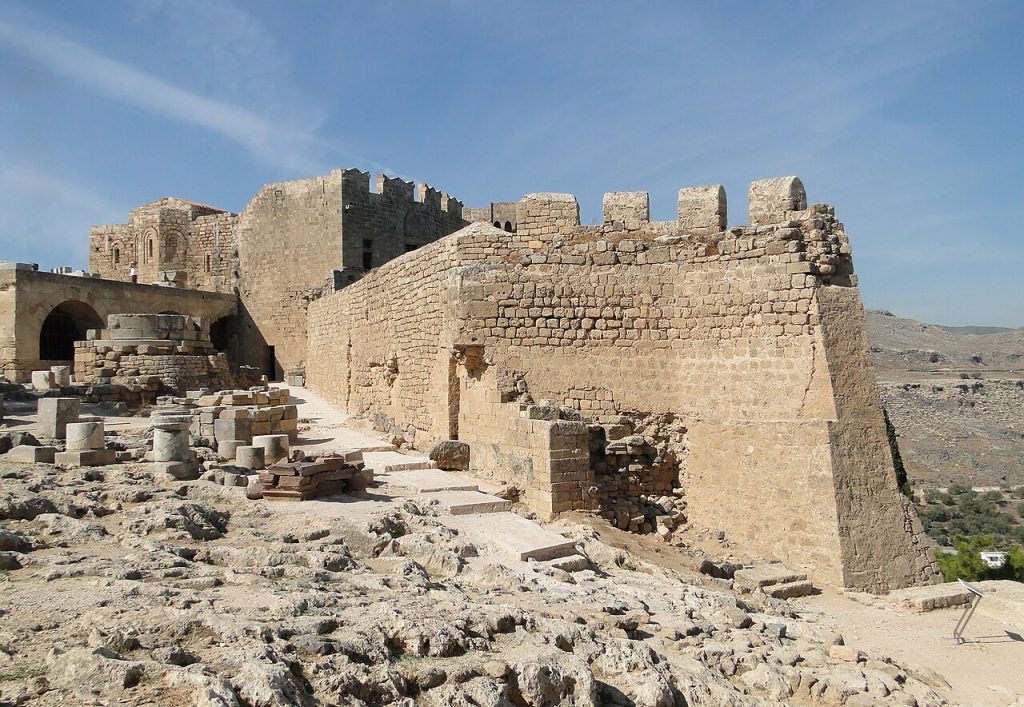
In the 14th century, the Knights of Saint John built a large fortress on the hill to defend the island against the Ottomans. Its thick walls now surround the ancient ruins. From the battlements, the views over the village and the bays are simply breathtaking.
The Whitewashed Village
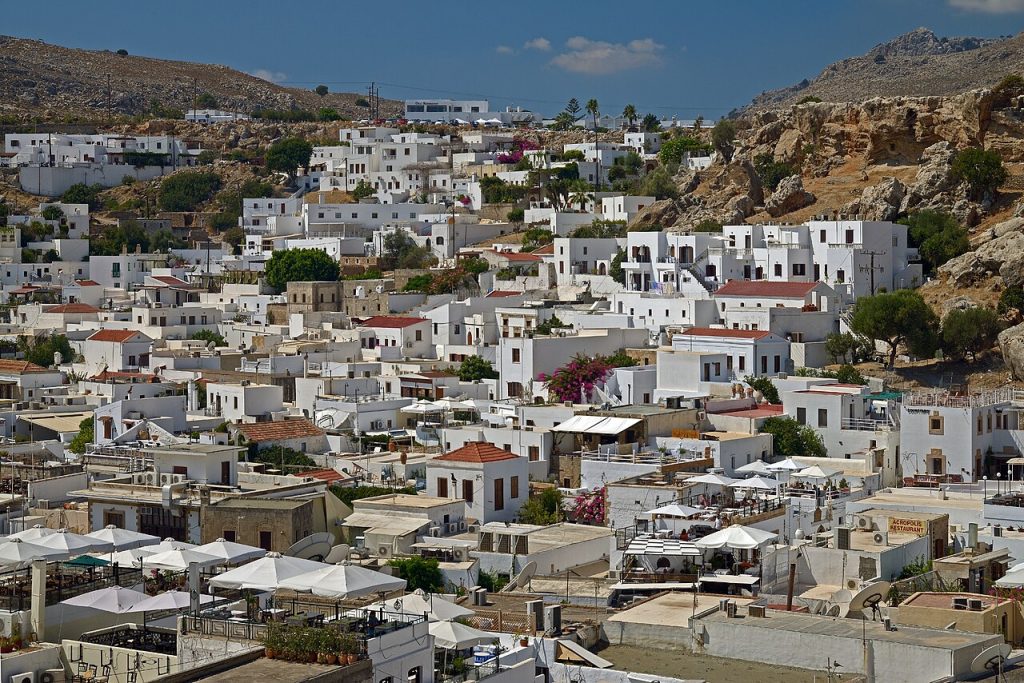
After the Acropolis, take time to explore the village itself. Its lanes are too narrow for cars, so the atmosphere is calm and car free. Instead, you will find small shops, cafés and rooftop restaurants with views of the hill.
Look out for the old captains’ houses. Wealthy sea captains built them in past centuries, with carved stone doorways and inner courtyards. Many of these courtyards have floors of black and white pebble mosaics, a traditional craft of Rhodes.
In the center of the village stands the Byzantine Church of Panagia. Inside, colorful frescoes cover the walls and ceiling. Similarly, its bell tower is a landmark that you can see from all over town.
Beaches and Bays Around Lindos
The Main Bay
Lindos Beach
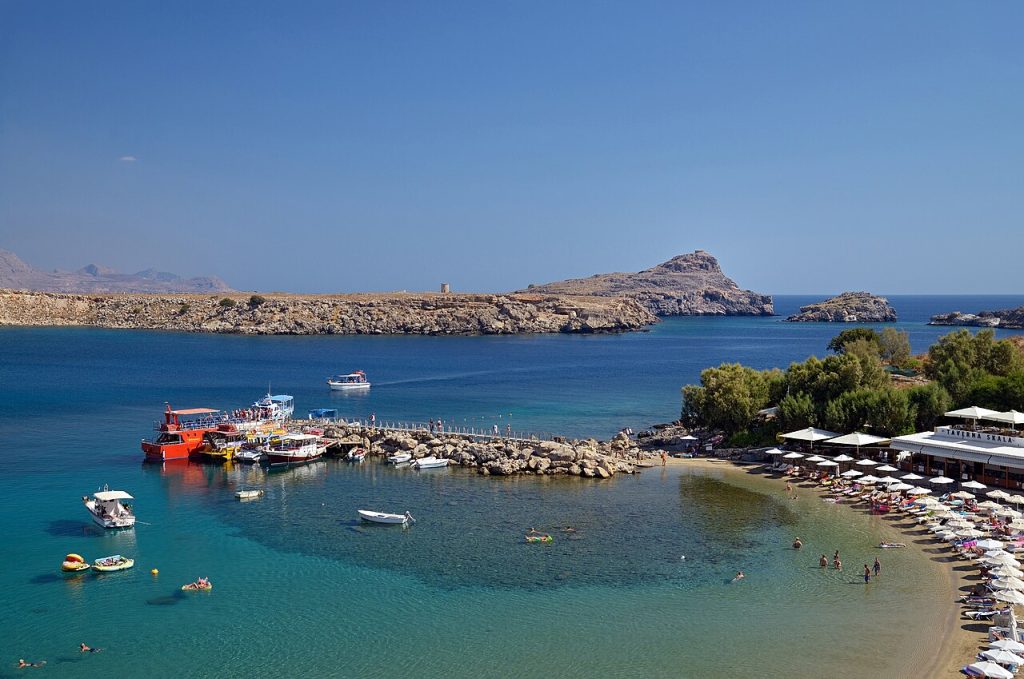
The main beach of Lindos curves around a wide bay just below the village. Its calm water is perfect for swimming, and there are sunbeds, tavernas and water sports.
Saint Paul’s Bay
A Hidden Lagoon
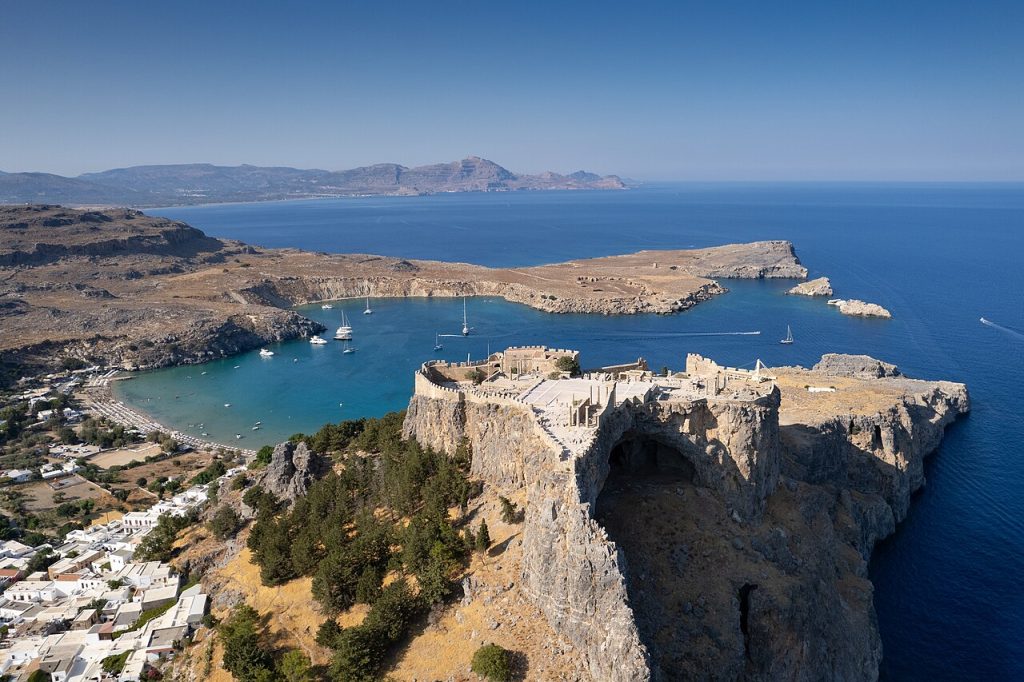
On the other side of the Acropolis lies Saint Paul’s Bay, a small, almost enclosed lagoon. According to tradition, the Apostle Paul landed here on his way to Rome. Today, a little white chapel stands by the shore, and the water is clear and calm.
Nearby Beaches
Pefkos and Charaki
If you want more space, head to the nearby beaches of Pefkos to the south or Charaki to the north. Both are quieter, and they make a pleasant half day trip.
One Historical Fact About Lindos, Greece
In the 6th century BC, Lindos was ruled by Cleobulus, one of the Seven Sages of ancient Greece. At that time, it was one of the most important cities on Rhodes and a major trading center. However, its power declined after the new city of Rhodes was founded in the late 5th century BC.
How to Get to Lindos, Greece
The nearest airport is Rhodes Diagoras, which has flights from Athens and many European cities. From there, the drive to Lindos takes about an hour. Alternatively, regular buses run from Rhodes Town, and boat trips also visit Lindos in summer.
Cars cannot enter the village. Instead, park in one of the car parks at the top of the hill and walk down.
Best Time to Visit Lindos, Greece
The best time to visit is from May to June or in September and October. During these months, the weather is warm, and the sea is pleasant for swimming. In contrast, July and August are very hot and crowded. So, if you visit in summer, climb the Acropolis early in the morning, because there is little shade.
Winter, on the other hand, is quiet. Although many hotels and restaurants close, the village is peaceful and the light is beautiful.
Is Lindos, Greece Worth Visiting?
Yes, absolutely. Lindos combines an ancient Acropolis, a medieval castle and a charming white village in one unforgettable setting. Moreover, the beaches below are perfect for a relaxing afternoon. In short, it is one of the highlights of Rhodes.
Final Thoughts
Lindos, Greece is a place where history and the Aegean Sea meet in perfect harmony. So, climb to the Acropolis, wander the white lanes and swim in Saint Paul’s Bay. In the end, you will understand why travelers have loved this village for centuries.
Planning a longer trip? You can also pair this visit with our guides to Monemvasia, Mdina and Cefalù.
Image Credits
Wikimedia Commons
- Lindos and the Acropolis: Photo by Following Hadrian via Wikimedia Commons (CC BY-SA 2.0)
- View of Lindos From the Acropolis: Photo by Ввласенко via Wikimedia Commons (CC BY-SA 3.0)
- Temple of Athena Lindia: Photo by Jebulon via Wikimedia Commons (CC0)
- Acropolis of Lindos Fortress: Photo by Bernard Gagnon via Wikimedia Commons (CC BY-SA 3.0)
- Pier at Lindos: Photo by Ввласенко via Wikimedia Commons (CC BY-SA 3.0)
- Acropolis of Lindos From Above: Photo by Thomas Berwing via Wikimedia Commons (CC BY-SA 4.0)