Hallstatt Austria: Guide to the Alpine Lake Village

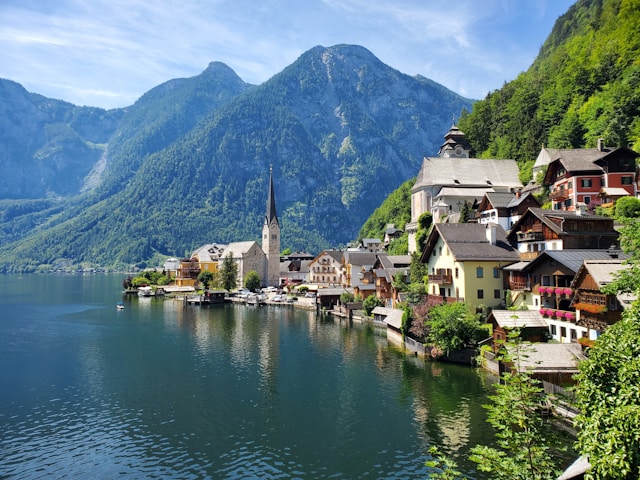
Hallstatt sits on a narrow shelf of land between Lake Hallstatt and the Dachstein mountains. Wooden houses stack tightly against the hillside, and a church spire rises above the rooftops. Visitors come for the lake views, but they stay for the stone staircases and quiet market square. So, this guide covers everything you need to plan a trip to Hallstatt, Austria.

Wooden houses and a church spire along the shore of Lake Hallstatt beneath alpine peaks
Hallstatt’s lakefront houses framed by the Austrian Alps

Quick Facts About Hallstatt, Austria

Country Austria
Region Salzkammergut, Upper Austria
Known For Lakeside views, a historic saltmine, stone staircases, and a colorful Marktplatz
UNESCO Status UNESCO World Heritage Site, Hallstatt-Dachstein Salzkammergut Cultural Landscape, since 1997
Founded Settled since prehistoric times, with salt mining dating back more than 7,000 years
Best Time to Visit Spring and autumn
Time Needed Half a day to one full day
Continent Europe

Where is Hallstatt, Austria?

In fact, Hallstatt lies in the Salzkammergut region of Upper Austria. It also sits on the western shore of Lake Hallstatt, beneath the steep slopes of the Dachstein massif. Since the village fits onto such a narrow strip of land, most streets run as stairs rather than roads. Still, this tight layout is part of what makes Hallstatt so recognizable.

Map showing the location of Hallstatt in the Salzkammergut region of Austria.

Why Visit Hallstatt, Austria?

Hallstatt offers scenery that few villages can match. Its wooden houses cling to the hillside, and the lake mirrors the mountains on calm days. Since the village sits inside a UNESCO listed cultural landscape, its historic character stays well protected. The saltmine adds another layer too, with tunnels that date back thousands of years. Many travelers also pair Hallstatt with the wider Salzkammergut lake region. So, it works well as a stop on a longer Alpine itinerary. Along the shore, the church spire and stone staircases give the village its instantly recognizable silhouette.

Hallstatt’s Lake and Village Views

In fact, Hallstatt’s setting shapes almost everything about the village. The lake, the church, and the stone staircases all sit within a few hundred meters of each other. Since space is so limited, every corner offers a slightly different view of the same dramatic landscape.

Lake Hallstatt from the Shore

Lake Hallstatt reflects the mountains on quiet mornings and glows at blue hour once the village lights turn on. Swans often drift past the lakefront houses in autumn, and small boats cross the water throughout the day. A yellow house draped in red vines overlooks the shoreline, while stone steps nearby lead down toward the water. Further along, a clear mountain stream cuts straight through the village on its way to the lake.

Hallstatt's illuminated church tower reflected in the lake at blue hour beneath snow covered peaks
Blue hour settles over Hallstatt’s lakefront and snowy peaks
Pink petunias on a wooden balcony overlooking Lake Hallstatt with a passing boat
A balcony framed in petunias overlooks Lake Hallstatt
Stone steps descending past wooden lakeside houses toward Hallstatt's church spire
Stone steps wind down to Hallstatt’s lakefront
A swan swimming past Hallstatt's lakefront houses in autumn light
Swans glide past Hallstatt’s hillside houses in autumn
A yellow lakefront house covered in red autumn vines above Lake Hallstatt
Autumn vines climb a yellow house above the lake
A clear mountain stream flowing through Hallstatt past houses and mountains
A mountain stream runs clear through Hallstatt

The Church Spire Above the Rooftops

Indeed, Hallstatt’s parish church anchors nearly every view of the village. Its spire rises above the rooftops, and pink roses often bloom just below the clock tower in summer. From the stone staircases nearby, visitors get a clear line of sight down to the church and the lake beyond. Narrow alleys throughout the village frame the tower from unexpected angles too.

Hallstatt's church clock tower rising above pink roses with the lake and mountains beyond
Pink roses frame Hallstatt’s church spire above the lake
View down a wooden staircase toward Hallstatt's church spire and lake
A stairway view over Hallstatt’s rooftops and church spire
A narrow Hallstatt alley leading toward the church clock tower
A narrow alley frames Hallstatt’s church tower

Climbing the Village’s Stone Steps and Balconies

Since Hallstatt has so little flat ground, stone staircases connect nearly every level of the village. Wooden balconies line these narrow lanes, many carved with detail and hung with flower boxes. Golden morning light often catches the hillside houses first, before it reaches the lake below. Vine covered alleys wind between guesthouses, and rooftops stack closely against the mountain. Above the village, a waterfall drops down the cliffs directly behind the houses, adding sound to the otherwise quiet streets.

Wooden balconied houses on Hallstatt's steep hillside lit by golden morning light
Golden light catches Hallstatt’s steep hillside homes
A narrow alley lined with vine covered historic houses in Hallstatt
A quiet alley winds through Hallstatt’s old town
A cobblestone street lined with traditional wooden guesthouses in Hallstatt
Traditional guesthouses line a quiet Hallstatt street
Houses stacked on Hallstatt's steep hillside beneath rocky mountain cliffs
Houses stack tightly against Hallstatt’s steep hillside
Colorful houses with flower filled balconies climbing Hallstatt's hillside
Flower balconies brighten Hallstatt’s climbing hillside village
A waterfall cascading down the cliffs behind Hallstatt's village houses
A waterfall spills down the cliffs above Hallstatt

The Hallstatt Salt Mine

Hallstatt’s saltmine ranks among the oldest in the world, with mining evidence dating back more than 7,000 years. A funicular usually carries visitors up the mountainside to the entrance, so the climb itself takes little effort. As of this writing, the mine, the Skywalk, and the funicular are closed for construction. Reopening is still planned for September 2026. Once open again, the tunnels stay cool year round, and illuminated halite crystals glow along the walking route. Since the mine predates written history in the region, archaeologists still study it for clues about prehistoric life. A wooden slide partway through the tour also lets visitors drop quickly between tunnel levels. So, this makes the visit feel less like a museum and more like an adventure. Travelers planning a trip soon should still check current opening dates before they go.

The path from Hallstatt's funicular station toward the historic saltmine
A quiet path leads toward Hallstatt’s historic saltmine
Illuminated halite salt crystals displayed inside Hallstatt's saltmine
Salt crystals glow inside Hallstatt’s ancient saltmine

Hallstatt’s Marktplatz and Local Traditions

Hallstatt’s Marktplatz sits just a short walk from the lake, and it functions as the village’s social center. Cafes, shops, and colorful houses surround the square, so it makes a natural stop at any point during a visit.

The Colorful Marktplatz

Flowers and Facades Around the Square

Red, white, and yellow houses line the Marktplatz, many with window boxes overflowing with flowers. A few facades still stack firewood against the wall, a practical touch that has become part of the square’s charm. Cafes set out tables beneath the buildings, and visitors often pause here between walks through the old town.

Colorful red, white, and yellow facades lining Hallstatt's market square
Pastel facades brighten Hallstatt’s market square
Colorful houses and outdoor cafes along a Hallstatt street
Cafes and colorful facades line a Hallstatt street
Flower draped balconies along a sunny street in Hallstatt's market area
Flower boxes brighten a sunny Hallstatt street
Colorful Marktplatz houses in Hallstatt with an autumn tree growing up the wall
Autumn color climbs a Hallstatt Marktplatz facade

The Trinity Column and Salzkontor

In fact, a carved stone Trinity Column stands at the center of the Marktplatz. It was once raised in gratitude after the village survived a plague. Nearby, the historic Salzkontor building still bears painted decoration from its earlier days as a salt trading house. Both landmarks anchor the square, so they make an easy meeting point before exploring further.

The Holy Trinity Column standing in Hallstatt's market square
The Holy Trinity Column marks Hallstatt’s market square
Orange, white, and green houses with stacked firewood in Hallstatt's market square
Firewood and flowers decorate a Marktplatz facade
Morning light on Hallstatt's village street near the historic Salzkontor building
Summer morning light fills a Hallstatt village street

Festivals and Quiet Streets Beyond the Square

Once a year, Hallstatt holds a lake procession during Corpus Christi, when decorated boats carry participants across the water. Beyond the festival, the village still settles into a quieter rhythm. Pink and yellow houses line the lakeside promenade, and one wall still supports a pear tree trained against its facade. Further along, a pink corner house catches the evening light, its shutters closed against the cool mountain air.

Traditional decorated boats carrying a lake procession past Hallstatt's church
A traditional boat procession crosses Lake Hallstatt
A pear tree espaliered against a pink house along Hallstatt's lakeside promenade
A pear tree grows against a house on the promenade
A pink corner house on Salzbergstraße in Hallstatt with mountains behind
A pink corner house catches evening light in Hallstatt
A yellow house with green shutters beneath a mountain in Hallstatt
A yellow house sits quietly beneath Hallstatt’s mountains

One Historical Fact About Hallstatt, Austria

Hallstatt gave its name to an entire era of European prehistory, known today as the Hallstatt culture. Archaeologists began excavating the village’s ancient saltmine and a nearby prehistoric cemetery in the 1800s. The finds were so significant that the early Iron Age, roughly 800 to 450 BC, now carries the site’s name. Salt mining here stretches back more than 7,000 years, so Hallstatt ranks among the oldest worked industrial sites in the world. So, this deep history explains why the surrounding region earned UNESCO recognition in 1997.

How to Get To Hallstatt, Austria

Generally, the easiest route to Hallstatt starts in Salzburg. From there, a regional train reaches Hallstatt station in about an hour and a half. A short ferry then crosses the lake into the village, since Hallstatt has no train stop on its own shore. Travelers coming from Vienna can also reach Hallstatt by train, though the trip takes about four hours with a transfer. Those driving from Salzburg or Vienna will find limited parking, so many visitors park outside and walk in instead.

Best Time to Visit Hallstatt, Austria

Spring and autumn both offer strong reasons to visit Hallstatt. In spring, wildflowers also line the stone staircases. Autumn, meanwhile, brings fewer crowds and warm colors across the hillside. Summer draws the largest number of visitors, so travelers who want quieter streets should plan around the shoulder seasons instead. Winter, on the other hand, blankets the village in snow and gives the lake a stiller, quieter feel.

Is Hallstatt, Austria Worth Visiting?

In fact, Hallstatt is worth visiting, especially for travelers drawn to dramatic lake and mountain scenery. The saltmine, the Marktplatz, and the stone staircases each offer a different side of the village within a small area too. Since it also connects easily to the wider Salzkammergut region, Hallstatt fits naturally into a longer Austrian Alps itinerary.

Final Thoughts

Hallstatt shows how much history and scenery can fit into one small village. Its lake views, saltmine, and colorful Marktplatz give visitors plenty to explore in just a day or two. For example, read our guide to Takayama, Japan, another mountain town shaped by its centuries old streets.

Image Credits

Unsplash

Pixabay

Pexels

Wikimedia Commons

  • Anton NikiforovCC BY 3.0, via Wikimedia Commons: The Holy Trinity Column Marks Hallstatt’s Market Square.
  • Anton NikiforovCC BY 3.0, via Wikimedia Commons: A Mountain Stream Runs Clear Through Hallstatt.
  • Karelj, Public domain, via Wikimedia Commons: A Quiet Path Leads Toward Hallstatt’s Historic Saltmine.
  • Andrew BossiCC BY-SA 2.5, via Wikimedia Commons: Firewood and Flowers Decorate a Marktplatz Facade.
  • GhirlandajoCC BY-SA 4.0, via Wikimedia Commons: Flower Boxes Brighten a Sunny Hallstatt Street.
  • Karelj, Public domain, via Wikimedia Commons: Salt Crystals Glow Inside Hallstatt’s Ancient Saltmine.
  • Lucy LiuCC BY-SA 3.0, via Wikimedia Commons: Autumn Color Climbs a Hallstatt Marktplatz Facade.
  • David KernanCC BY 4.0, via Wikimedia Commons: Summer Morning Light Fills a Hallstatt Village Street.
  • Andreas StiasnyCC BY-SA 4.0, via Wikimedia Commons, CC BY-SA 4.0: A Pink Corner House Catches Evening Light in Hallstatt.
  • Jitka Erbenová (cheva)CC BY-SA 3.0, via Wikimedia Commons: A Pear Tree Grows Against a House on the Promenade.
  • Dimitry Anikin, CC0, via Wikimedia Commons: A Yellow House Sits Quietly Beneath Hallstatt’s Mountains.

Sources

Scroll to Top